

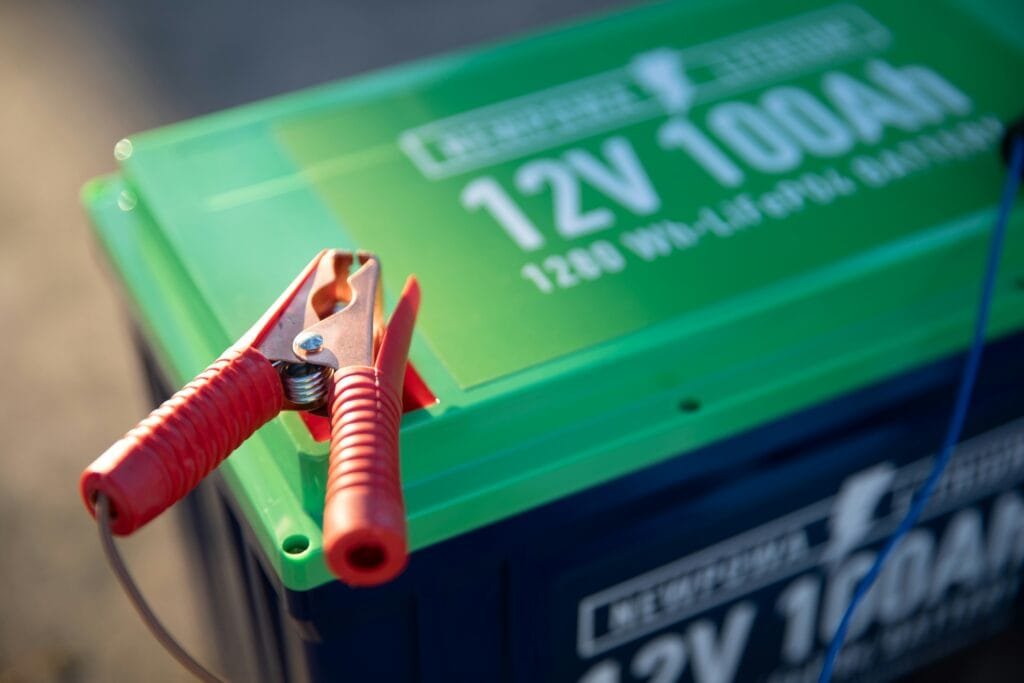
At a Glance
- Choosing the right electrical system voltage is an important decision when designing an off-grid setup, as it affects efficiency, equipment choice, and future expansion.
- 12V systems are commonly used for smaller setups such as campervans and simple cabins, while 24V and 48V systems are better suited to larger energy demands.
- Many off-grid systems combine different voltages, with batteries storing energy at 12V, 24V, or 48V and inverters converting power for standard 230-240V appliances.
- The best voltage depends on your actual energy needs, lifestyle, and plans for the future rather than simply choosing the largest system possible.
When designing an off-grid electrical system, one of the first decisions you’ll need to make is the system voltage. Most off-grid setups operate at either 12V, 24V, or 48V, while many household appliances still run on standard 230-240V AC power through an inverter.
Your choice of off-grid electrical system voltage affects more than you might think. It influences efficiency, cable sizing, equipment options, system cost, and how easily you can expand in the future.
The good news is that there isn’t a universally “best” voltage. The right choice depends on the type of off-grid home you’re building and how much power you expect to use.
Understanding Voltage Without the Technical Jargon
A simple way to think about voltage is as electrical pressure.
If electricity were water flowing through a pipe:
- Voltage would be the water pressure
- Current (amps) would be the amount of water flowing
Higher voltage allows you to move the same amount of power using less current. In practical terms, that means smaller cables, less heat and less energy lost in wiring.
You don’t need to understand the mathematics behind it. The important point is that larger systems generally become more efficient as voltage increases.
12V Systems: The Small-System Standard
Twelve-volt systems are extremely common in off-grid living because many vehicles already operate on 12V electrical systems.
You’ll often find 12V setups in:
- Campervans
- Small boats
- Weekend cabins
- Portable power stations
There are some clear advantages. Components are widely available, most installers are familiar with them, and there is a huge range of 12V appliances designed specifically for mobile living.
The downside is that as power demand increases, so does current. Higher current requires thicker cables and can make larger systems less efficient and more expensive to wire correctly.
For smaller off-grid setups with modest energy requirements, 12V remains a sensible and proven choice.
24V Systems: The Middle Ground
As systems become larger, many people move to 24V.
This is particularly common in:
- Larger camper conversions
- Expedition trucks
- Liveaboard boats
- Medium-sized cabins
One advantage is that many larger commercial vehicles and trucks already operate on 24V electrical systems. Matching the habitation system to the vehicle voltage can simplify charging arrangements and provide redundancy, allowing the vehicle and living systems to work together more easily. The same principle applies to 12V vehicles.
Compared with 12V, a 24V system requires less current to deliver the same power. This means smaller cables, lower losses, and more room for future expansion.
The trade-off is slightly increased complexity and a smaller range of dedicated 24V appliances. In practice, however, most people running larger off-grid systems find 24V offers an excellent balance between simplicity and efficiency.
For many full-time off-grid setups, 24V is often the sweet spot.
48V Systems: For Larger Off-Grid Homes
Once power demands become substantial, 48V starts to make a lot of sense.
You’ll commonly see 48V systems in:
- Permanent off-grid houses
- Workshops
- Smallholdings
- High-consumption households
- More complex installations
Because the voltage is higher, the current required is much lower. This improves efficiency and allows for smaller cable sizes throughout the system.
Forty-eight-volt systems are also particularly well suited to larger battery banks and more powerful inverters.
The downside is that they can be unnecessarily complex for most smaller homes, boats, or vehicles. If you’re only running a few lights, a fridge, and some device charging, a 48V system is unlikely to offer enough benefit to justify the additional complexity.
For larger installations, however, it is often the preferred option.
Where Does 240V Fit Into All This?
This is where many people get confused. Most off-grid systems are not actually 240V systems.
Instead, energy is stored in batteries at 12V, 24V, or 48V. An inverter then converts that battery power into 230-240V AC electricity, just like the power supplied by the grid.
That allows you to run familiar household appliances such as kettles, washing machines, microwaves and power tools.
The battery voltage and appliance voltage are usually two separate things. Your battery bank might be 24V, while the appliances plugged into your sockets are all running at 240V.
Can You Mix Voltages?
Absolutely. In fact, most off-grid systems already do.
A typical setup might include:
- A 24V battery bank
- 240V household appliances
- USB charging at 5V
- Vehicle charging systems operating at 12V or 24V
The key is using the correct converters and equipment. Mixing voltages isn’t unusual, but it does need to be considered during the design stage rather than added as an afterthought.
How to Choose the Right Voltage
As a rough guide:
12V is good for:-
- A small campervan
- A weekend-use setup
- Relatively low energy demand
24V is good for:-
- A full-time vanlife build
- An expedition truck
- A liveaboard boat
- A medium-sized off-grid cabin
48V is good for:-
- A permanent off-grid home
- A large solar array
- Significant daily power consumption
It’s also worth considering where you may be in a few years. Designing for sensible future expansion can save both money and effort later.
The Best Voltage to Fit Your Off-Grid System
Many people spend too much time searching for the perfect voltage and not enough time understanding their actual energy needs. A well-designed 12V system will outperform a poorly planned 48V system every time.
Start by working out what you want to power, how much energy you’ll realistically use, and how you expect the system to grow. Once you understand those requirements, choosing the right off-grid electrical system voltage becomes much easier.
The goal isn’t to build the biggest system possible. It’s to build one that works reliably for the way you actually live.
To go back to basics, check out our Beginner’s Guide to Off-Grid Energy.