

At a Glance
- Composting toilets are a popular off-grid sanitation solution because they reduce or remove the need for traditional sewage systems.
- Different designs, including separating, incinerating, and larger composting systems, suit different homes, vehicles, and lifestyles.
- Choosing the right composting toilet depends on factors such as available space, usage levels, maintenance requirements, and local regulations.
- A well-designed system can provide a practical, low-water alternative while helping reduce waste and create a more sustainable off-grid setup.
When you move off-grid, one of the first practical decisions is how to manage your waste. Composting (or separating) toilets are one of the most widely used solutions, especially where ‘normal’ plumbing or septic systems aren’t practical. There are several well-established options available, each suited to different setups and priorities. This guide focuses on the top 5 most used composting toilets for off-grid homes, to help you choose the right one for your situation.
What Actually Matters When Choosing One
Before looking at specific models, it helps to understand the main differences.
Size is often the first factor, particularly in compact off-grid bathrooms, followed by capacity which determines how often you will need to empty it.
Ventilation is also important. Some toilets use electric fans to reduce odours, while others rely on passive airflow.
Finally, there is the balance between cost and convenience. Simpler toilets are usually cheaper but require more hands-on management. More expensive models tend to offer better capacity, build quality, and ease of use.
Top 5 Composting Toilets for Off-Grid Living
Air Head Composting Toilet
The Air Head is one of the most well-known composting toilets in the off-grid industry, and it shows in how well thought-out the design is. It separates liquids and solids effectively, uses a small 12V fan for ventilation, and includes a manual agitator to help break down waste. For a couple living full-time, the solids container typically lasts around 3–4 weeks before emptying, which is a strong balance for its size.
It is also compact and can be configured in different ways to suit tighter spaces. The main downside is cost, as it sits firmly in the premium category. It also still requires regular emptying of the urine container every day or two, which is standard but worth factoring in.
Separett Waterless Toilets
Separett toilets are designed to feel closer to a conventional household setup, which makes them a popular choice for large mobile homes and static off-grid set-ups. There is a range of sizes and capacities available from the Tiny to the Villa Extended. They use an electric fan for ventilation and often include larger containers or continuous waste systems, meaning less frequent emptying compared to smaller units.
The biggest benefit here is convenience. With higher capacity and automatic separation, they are easier to live with day-to-day, especially for full-time use.
However, they do require power and more space, which limits their suitability for smaller builds. They are also less portable and involve a more fixed installation, so they are not as flexible as some compact units.
Nature’s Head Composting Toilet
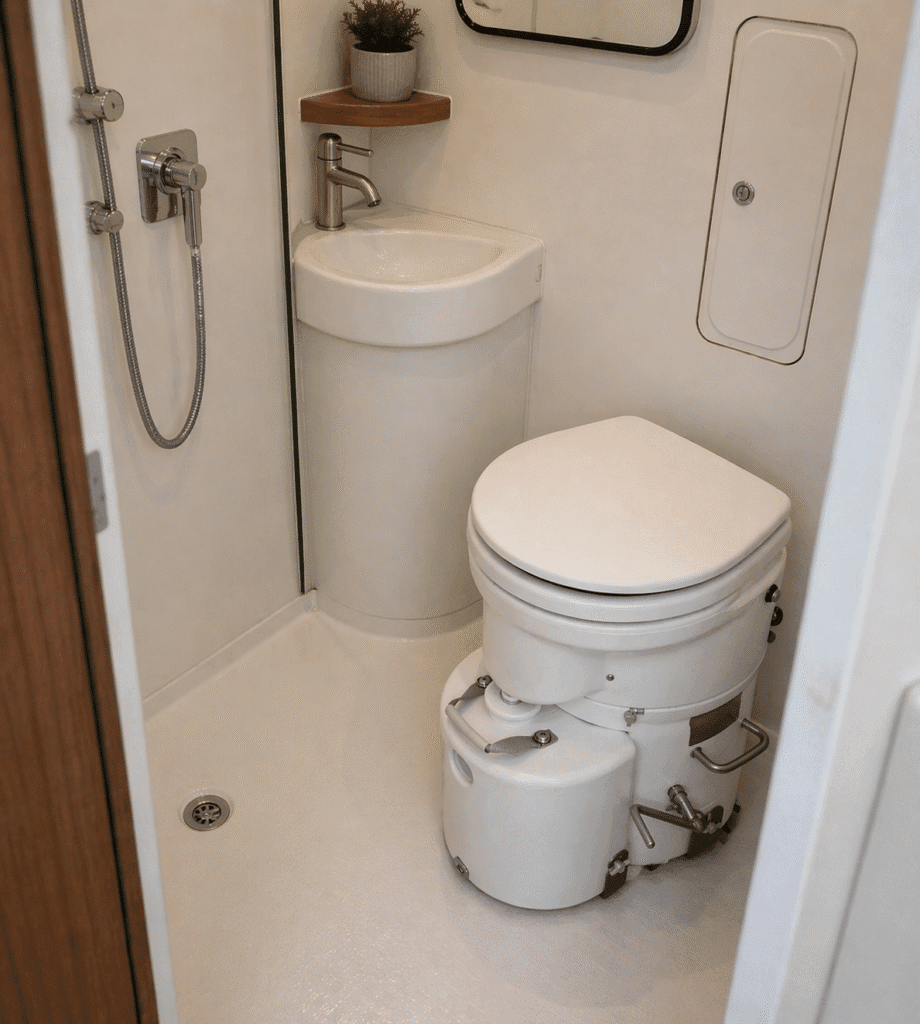
Nature’s Head is one of the most commonly used composting toilets, particularly in van conversions and boats. It has a simple, self-contained design with a manual crank system that mixes solid waste with composting material.
It has been widely used for years, and spare parts and support are easy to find, especially in the USA. The separation system works well, helping to reduce odours when set up correctly.
That said, it is not the smallest option, and the internal space can fill relatively quickly with full-time use. Like similar designs, it relies on regular emptying and some user awareness to keep liquids and solids properly separated.
TROBOLO Separating Toilets
TROBOLO toilets are aimed at those looking for a simpler, more affordable entry point into composting toilets. Their range includes both ready-made units and more DIY-style systems, making them flexible depending on your setup.
The main advantage is cost. You can get a functional separating toilet without the higher price tag of premium brands. They also tend to be straightforward in design, with fewer components that can go wrong.
The trade-off is convenience. Most models do not include electric fans, and overall capacity and finish are more basic. This means more hands-on management and potentially more attention to ventilation to keep things working well.
Trelino Composting Toilets
Trelino toilets are designed with simplicity and portability in mind. They are lightweight, require no installation, and are easy to move or store, which makes them a good option for smaller spaces or occasional use.
They come in a range of sizes, so you can choose something that fits your layout, whether that is a van, shed, or temporary setup.
The main limitation is capacity. Because they are compact, both liquid and solid containers need to be emptied more frequently, especially for full-time use. They also rely on passive systems rather than powered ventilation, so airflow and setup become more important to manage odour effectively.
A Practical Part of Off-Grid Living
Each of these toilets suits a slightly different type of setup. The best option depends on how you plan to live. Composting toilets are not completely hands-off. They require emptying, cleaning, and a basic level of maintenance. However, they remove the need for plumbing, reduce water use, and make off-grid setups far more flexible.
With the right choice, they become a reliable and manageable part of daily life. While there are a number of others available, these are the top 5 most commonly used composting toilets. The choice comes down to how much space you have, how often the toilet will be used, and how much time you are willing to spend managing it.
Some of the links in this article are affiliate links, meaning we may earn a small commission if you choose to purchase through them, at no extra cost to you.
To discover other off-grid toilet options click here.
To find out more about off-grid living return to our Reading Room.