At a Glance
- Pipes freeze long before tanks do, so insulate and shorten the pipework first and worry about the tank second.
- An IBC or outdoor tank survives most winters with insulation, shelter from the wind and a cover over the tap end.
- Trace heating works off-grid, but it draws power in the darkest weeks, so budget for it or use it sparingly.
- The right mix depends on whether you’re in a house, a vehicle or a boat, and how cold your winters really get.
Keeping an off-grid water system from freezing can be surprisingly difficult because the tank and pipework may be exposed to very different conditions. The tank might be an IBC sitting in a field, a water tank under a camper or part of a larger system inside a boat. This piece covers all three, a fixed house or cabin, a live-in vehicle and a boat, because the physics is the same and only the fixes change.
Water doesn’t freeze all at once. It freezes from the outside in, and it freezes fastest where there’s least of it. That one fact tells you where to spend your effort.
Why Pipes Freeze First
Leave a full bath and a teacup outside on a frosty night and the teacup is solid by morning while the bath has a skin of ice. A thousand litres of water in an IBC will maintain an ambient temperature which changes very slowly. The water in a 15mm pipe changes temperature much faster.
That’s why the first sign of trouble is nearly always a tap that won’t run, not a frozen tank. The pipe from the tank to the house, the pump housing, the outside tap and any exposed run under a vehicle are the weak points.
Insulating an IBC Tank
IBC tank insulation doesn’t need to be clever. The cage makes it easy to wrap: a layer of foil bubble wrap or closed-cell foam boards on all four sides and the top, with the joints taped, makes a real difference.
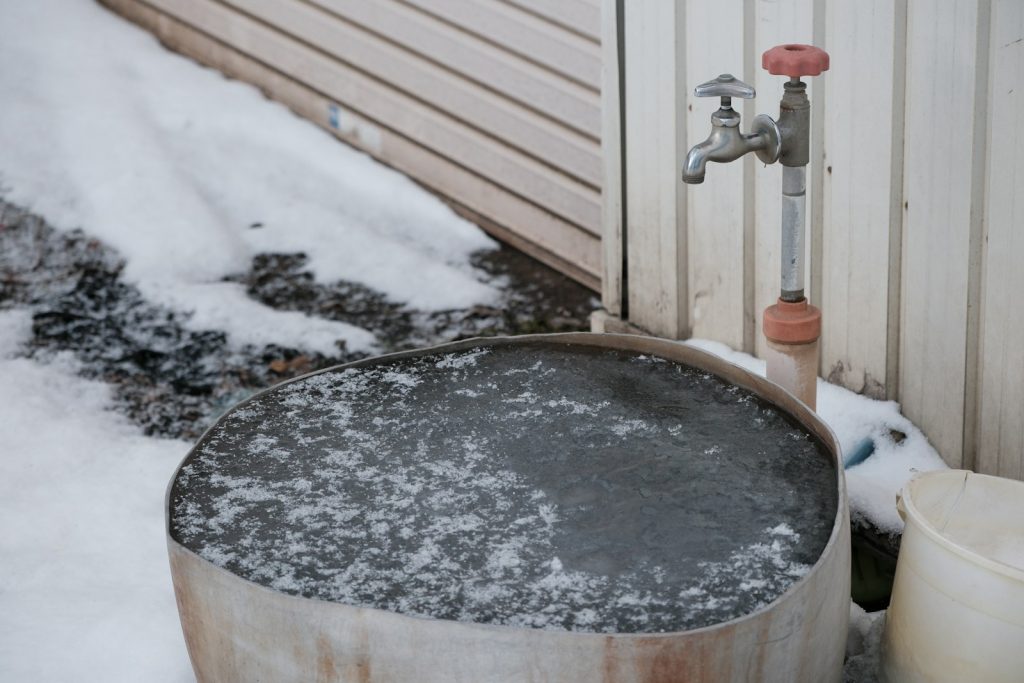
The tap and the pipe leaving it are the part everyone forgets, and they’re the part that freezes. Box the tap end in with foam and a hinged lid so you can still get to it, and keep the outlet pipe as short as you can. Leave the tank in the sun if there’s any sun to be had, and out of the wind, because wind strips heat far faster than still air.
Keeping it full helps too, because more water means the temperature changes more slowly. A tank you let run down to the last hundred litres in January is a small tank, and small tanks freeze.
Bury It or Bring It Inside
Insulation slows heat loss, but the ground does a better job. Soil a little way down stays above freezing through all but the harshest winters, so a buried tank or a buried supply pipe rarely gives trouble. How deep depends on where you live. In the UK, for example, buried water pipes are normally laid at least 750mm down to stay clear of frost, but in continental climates frost can go much deeper, so check the usual frost depth for your area before you dig.
If digging isn’t an option, a tank inside a shed or a lean-to sits in air a few degrees warmer than open ground, and a few degrees is often the difference.
In a camper conversion, the answer is usually to keep the tank and pipework inside the insulated part of the vehicle, not slung underneath. If a tank has to sit underneath, insulate it and fit a tank heater. On a boat, a tank down in the hull below the waterline is sitting against water that rarely drops far below zero, so it’s usually the pipes running up into the cabin that need lagging, not the tank.
Keep the Water Moving
Moving water freezes far less readily than still water, which is why streams keep running when ponds have frozen over. If you’ve got a pump, a timer that runs it for a minute every hour or two through a cold night keeps the pipe from settling into ice, provided a tap is left open. A tap left dripping into a bucket does the same job.
The trade-off is power and water. Every pump cycle costs battery at the time of year you have the least, and a drip that runs all night is water wasted, so save this for the coldest nights rather than running it all winter.
Trace Heating Without Mains
Trace heating is a cable that runs along a pipe or around a tank and warms it gently. The self-regulating kind is the one to look for, because it draws more current when it’s cold and less as the pipe warms, and with a thermostat it only runs when it’s needed. You can get it in 12V and 24V versions for vehicles and boats, or 230V run through your inverter for a house.
The tricky part is when it runs. It works hardest in the exact weeks your panels do least, so it’s a winter power drain on top of heating and lights. A short run on the vulnerable pipe from tank to house is manageable on most systems. Wrapping a whole IBC in it is a generator job. Sort out your solar in winter before you rely on it.
Wherever it’s fitted, lag over the top of it, and put it on its own fused circuit, with an RCD as well if it runs on 230V. And don’t add automotive antifreeze to a drinking water tank, because it’s poisonous.
When It Freezes Anyway
Even with good protection, a pipe will sometimes freeze. When a tap stops, open it first, so melting water has somewhere to go, then warm the pipe gently from the tap end back towards the tank with warm cloths, a hot water bottle or a hairdryer if you can spare the power. Never use a naked flame on any pipe or tank. Then check the whole run for splits once it’s thawed.
The best protection is a reserve. Keep a few days of drinking water in containers inside the warm part of the home through winter, and you can afford to let a frozen pipe thaw in its own time. Knowing how much water you get through tells you how big that reserve needs to be.
Final Thoughts
The right way to keep your water from freezing depends on what you live in and how hard your winters bite. A house with a buried supply and a wrapped tank may never need anything more. A vehicle needs its water inside the insulated living space, or a tank heater where it can’t be. A boat needs lagged cabin pipework and a warm cabin.
Start with insulation, add shelter, keep a reserve, and only then spend on trace heating. Protecting your water through winter comes down to habits more than purchases, and it sits alongside the rest of off-grid winter living.
If you live on a boat and would rather have someone sort the pipework for you, the Business Catalogue includes a marine engineer who takes on plumbing repairs.
To find out more about off-grid living return to our Reading Room.