

At a Glance
- One person in a mains-connected home in the UK uses around 140 litres a day. Off-grid, most people manage on 20 to 80.
- Campers and boats sit at the low end of that scale, houses with more complex water systems at the high end.
- Size storage by days between refills or dry spells, not by the biggest tank you can fit.
- A composting toilet is the single biggest saving, because flushing is a third of a mains household’s water.
Whether you’re planning an off-grid house on a plot, a camper or a liveaboard boat, the water question comes in two halves. How much will you actually use each day, and how much do you need to keep in hand between one fill and the next? Get the first number wrong and your water supply could become a real challenge, not just a chore.
This is a sizing article, not a sourcing one. Where your water comes from, whether rain, a borehole, a spring or a tap at the marina, and how you treat it, are covered elsewhere in the Reading Room. Here the job is the arithmetic, and it’s simpler than the tank catalogues make it look.
How Much People Use
In a mains-connected home in the UK, the average person gets through roughly 140 litres a day, and homes without meters run higher still. That’s one country’s example. If you’re reading from elsewhere, check the figure your own water company or regulator publishes.
Off-grid, that figure drops, partly by design and partly because carrying water changes how you feel about it. The World Health Organization puts 20 litres a day as the minimum for basic drinking and hygiene, and 50 to 100 litres as the level at which health concerns fade. Most off-grid homes sit inside that band. A camper or small boat with a composting toilet and a careful shower routine often runs on 10 to 25 litres per person per day. A cabin or house with a high-pressure shower and a washing machine tends to land between 40 and 80 litres per person.
Where the Litres Go
It helps to see the day broken down into two main categories. Drinking and cooking is around three to five litres a person, and washing up five to fifteen depending on whether you use a bowl or a running tap. A mains power shower uses 10 to 15 litres a minute, so a ten-minute shower is 100 to 150 litres on its own, whereas a low-flow off-grid shower used intermittently rather than left running continuously is nearer 15 to 30. A household washing machine load is 50 to 70 litres.
Then there’s the toilet. A conventional flush toilet accounts for roughly a quarter to a third of mains household water. A composting or separating toilet uses none. Choosing a waterless toilet and keeping shower use low can make a substantial difference to your daily water requirement.
Sizing Storage by Days
How much water storage you need depends on two things: how much you use each day and how long you need to go between refills. Start by working out your realistic daily consumption, multiply it by the longest period you expect to go without topping up, then add a margin of a quarter or so.
Two people at 20 litres each who fill up every four days need about 200 litres, which is why a camper with a 100 to 150 litre tank refills twice a week and a narrowboat with a 500 to 1,000 litre tank refills every fortnight or so. A house on a rainwater or spring supply needs to protect against long dry spells, so a couple using 100 litres a day between them who want a month of cover need 3,000 litres plus margin, and a family wanting six weeks might be looking at 6,000 to 10,000 litres.
For rainwater, the alternative check is roof area in square metres multiplied by monthly rainfall in millimetres, then by about 0.8 for losses, which gives litres per month. A 60 square metre roof in a month with 60mm of rain collects roughly 2,900 litres. Compare that with what you use and the difference is the storage you need for the dry months.
Tanks and Where They Go
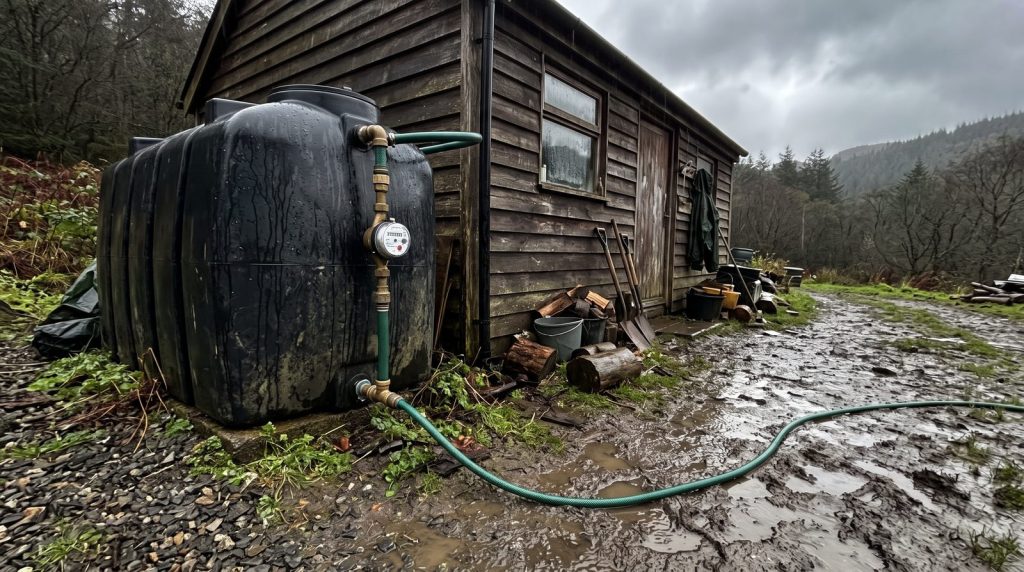
Once you know how many litres you need, the tank choice is much simpler. Campers use moulded plastic tanks from 50 to 400 litres, or portable containers you can lift to a tap. Boats carry integral tanks of a few hundred to a thousand litres in the bow. Plots and cabins use IBC containers, which hold 1,000 litres each and cost little second-hand as long as they’re food-grade and never held chemicals, or larger above-ground or buried tanks from 2,000 litres up.
Three practical rules apply everywhere. Keep stored water cool and dark, because sunlight grows algae and warmth makes it worse. Bury or insulate anything that has to survive winter, because a frozen IBC splits. And keep the tank sealed and screened against leaves, insects and animals, then clean it once a year. Where the tank feeds a gravity-fed off-grid water system, the height matters as much as the volume.
Keeping Stored Water Safe
Storage is where good water goes bad, so the tank and the treatment are one decision. What level of treatment your water needs depends on its source and use, and our guide to water treatment for off-grid homes walks through the levels.
One rule worth knowing if you’re in England: a private water supply to a single home that isn’t part of a business doesn’t have to be tested by the council, but under the Private Water Supplies (England) Regulations 2016 the local authority must carry out a risk assessment and monitoring if you ask them to. Wales, Scotland and Northern Ireland have their own versions, and other countries have their own arrangements, so check the guidance where you are.
Reducing Water Use
Reducing your daily water use can make a significant difference to the size of the system you need. A composting toilet, and a low-flow shower with a shut-off valve can dramatically reduce consumption. Using a bowl for washing up, and an efficient washing machine can reduce it further.
You don’t need to eliminate every convenience. The aim is to identify the uses that consume the most water and find sensible ways to reduce them.
Final Thoughts
There’s no single right answer to how much water storage you need for off-grid living. Count your daily litres honestly, decide how many days you need to cover, and size the tank to that with a margin.
To find out more about off-grid living return to our Reading Room.