At a Glance
- Hens slow down or stop laying in winter because the days get short, not because the weather turns cold.
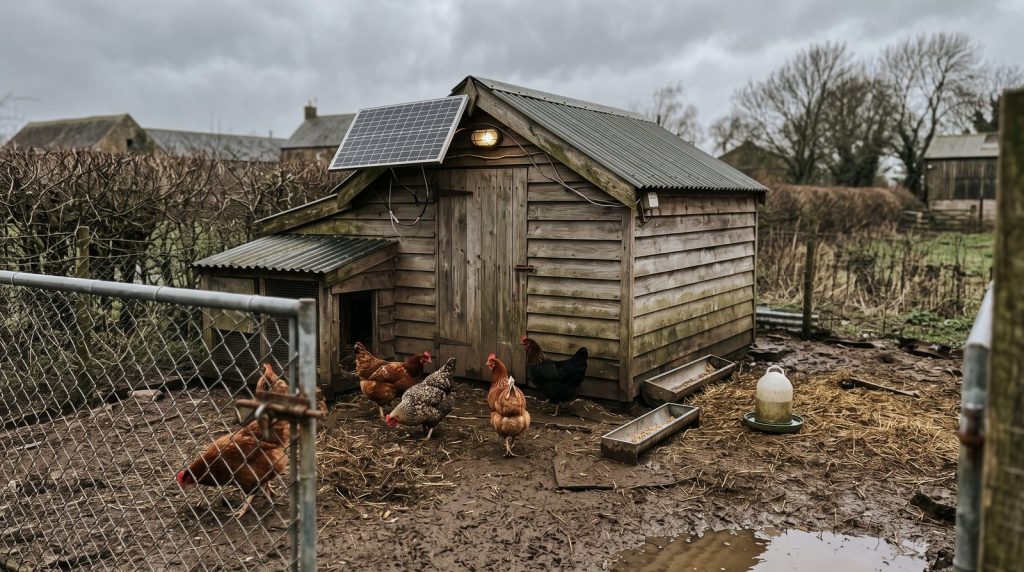
- Around 14 hours of light a day keeps most hens laying, and a small solar coop light on a timer can supply it.
- Add the extra light in the morning rather than the evening, so your birds still go to roost naturally at dusk.
- Whether to light at all depends on your flock, and letting older hens rest through winter is a fair choice too.
If you keep a few hens on a smallholding or plot with no mains electricity, the first winter can come as a shock. The eggs slow to a trickle in November and often stop by Christmas.
Working out how to keep chickens laying in winter is mostly a question of light, and light is the one thing an off-grid set-up can supply cheaply.
This piece is about winter laying only. If you’re new to hens altogether, start with our beginner’s guide to keeping poultry off-grid, which covers housing, feed and the daily routine.
The cold isn’t usually the problem; shorter days are.
Why Hens Stop Laying
A hen’s laying cycle is driven by day length. Once the days drop much below 14 hours, the hormones that trigger egg production ease off. Winter egg production in the UK falls away from October for that reason, well before the first hard frost.
Think of it like a shop that only opens when there’s enough daylight through the window. Give it a lamp and it keeps trading through the dark months.
How to Keep Chickens Laying in Winter
Top up natural daylight with artificial light so the total comes to around 14 hours a day. Going past 16 hours does no good and can stress the birds, so more is not better here.
The light doesn’t need to be bright. If you could read a newspaper at hen height, that’s enough, which is why a single low-watt LED does the job. Increase the extra light gradually, by 15 to 30 minutes a week.
Timing matters as much as duration. Add the light in the early morning rather than the evening.
If a lamp snaps off at 8pm the hens are left on the floor in sudden darkness, whereas a morning light lets them go to roost with the natural dusk.
Solar Coop Lighting That Works
Lighting a chicken coop off-grid is a small job for solar, because the load is tiny. A 3 to 5 watt LED running for four hours uses somewhere between 12 and 20 watt hours a day, and around the shortest days, when you may need six hours or more to reach 14, allow proportionally more.
A panel of 10 to 20 watts with a small battery covers that on most winter days, though a still, grey fortnight in December can flatten a small battery, so go a size bigger than the sums suggest.
You’ve got three ways to do it. A self-contained solar coop light with its own panel and battery is the simplest.
A rechargeable LED lantern you charge indoors is the cheapest, provided you remember it. Or, if the coop sits close to your main system, run a fused 12V feed from there through a timer.
Pick a unit with a proper timer rather than a dusk sensor, because a dusk sensor comes on at the wrong end of the day.
Mount it out of pecking reach, and remember LEDs run cool, which matters in a space full of dry bedding. If the coop is one part of a bigger plan, our piece on getting through a UK winter on solar explains why it’s important to size your system around the lowest-sunlight months.
Automatic Doors Earn Their Keep
A solar automatic pop-hole door is the other winter purchase that pays for itself.
It opens and closes on a timer or a light sensor, runs off a small panel and battery, and means nobody is trudging across a frozen field at 4pm to shut the birds away, safe from predators.
Run the light on a timer and the door on its light sensor, so the hens get their early light indoors but the door stays shut until real dawn. Look for a door with an anti-pinch reverse.
Warmth, Water and Feed
Hens don’t need a heated coop, and heating one is a poor use of off-grid power anyway. What they need is a draught-free house with ventilation up high, because damp does more harm in a UK winter than cold ever does.
Water is the daily chore. A black rubber bowl in the sun thaws faster than a plastic drinker, and topping up twice a day beats any gadget.
Feed layers pellets as normal, with a scoop of mixed corn late in the afternoon so they roost with something to digest, and keep grit available.
Deciding Whether to Light at All
There’s no single right answer, and it depends on your flock. Hybrid layers are bred to produce and will happily lay through a winter with some extra light.
Pure and heritage breeds, and any hen past her third winter, are often better off resting, because pushing them through uses reserves they’ll need in spring.
Register and Watch for Bird Flu
Two rules apply however small your flock. In Great Britain every bird keeper must be registered, even with a single hen, and must review the entry each year.
The requirement came into force in England and Wales on 1 October 2024 and in Scotland by 1 December 2024. It’s free and takes minutes through the Defra poultry registration service in England and Wales, or the Scottish Kept Bird Register in Scotland. If you’re reading from outside Great Britain, check the equivalent rule in your own area.
The second relates to avian flu. Housing orders in England tend to arrive in autumn or winter, and when one is declared your birds may have to be kept under cover, which cuts their daylight and makes a coop light more useful.
The last prevention zone was lifted on 4 June 2026, and you can check the current position on the GOV.UK bird flu page for England. Wales, Scotland and Northern Ireland publish their own.
Register once and confirm your details every year, then check the bird flu page each autumn.
Final Thoughts
Keeping hens laying through a UK winter without mains power comes down to one cheap fix and a few good habits. A low-watt LED on a morning timer, fed by a small solar panel, gives your birds the 14 hours their bodies are waiting for.
Dry housing, unfrozen water and a late-afternoon feed do the rest. Whether you light the coop at all is your call, and resting an older flock is as sensible as lighting a young one.
To find out more about off-grid living return to our Reading Room.