

At a Glance
- Liquids need emptying every one to three days, solids every one to eight weeks depending on the toilet and how many use it.
- Urine can go down an Elsan point, a normal toilet, or diluted onto non-edible planting.
- Solids are not allowed in Canal & River Trust (CRT) bins or Elsan points, so boaters must compost them or use a collection service.
- Composted for a year or more, the solids can go on ornamental planting, but never on salad or root crops.
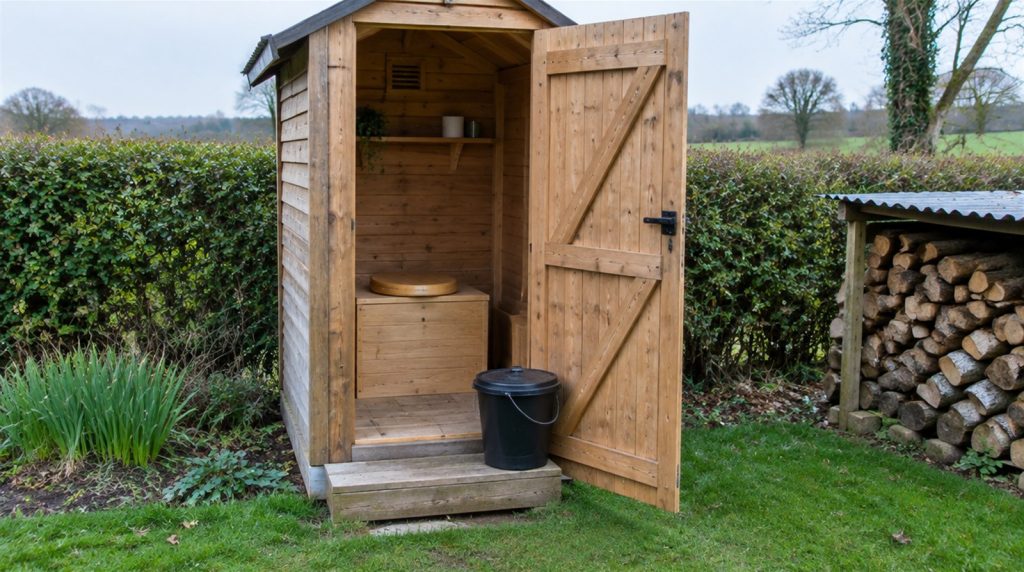
Choosing a composting toilet is the easy part. Whether it’s fitted in a camper, on a narrowboat or in an off-grid house or cabin, the question that arrives a fortnight later is what you actually do with the contents, and where you’re allowed to put them. Emptying the liquids is simple almost anywhere, and where the solids can go comes down to which type of home you’re in.
This article is about emptying and disposal only. How separating toilets work and which one to buy are covered in our top 5 composting toilets and the wider guide to choosing your off-grid toilet. The rules below are the UK ones, mainly England and Wales, and the practical steps apply anywhere. If you’re elsewhere, check the guidance from your own waterway authority, council and environment regulator.
How Often You Empty It
Most composting toilets sold for off-grid use are separating ones, with urine going to one container and solids to another. The liquid container fills fastest. For two people it’s typically a day or two, or longer with a bigger container, and it’s the job you’ll do most often, so make sure the bottle is easy to lift out and carry.
The solids container fills far more slowly. In a camper, a compact model in daily use by two people may need emptying about once a week. A full-size unit with a larger bin stretches to two or three weeks, and some of the bigger fixed installations for a cabin or house go six to eight weeks. Occasional use in a weekend hut can go months. The maker’s own figure for your model is the best guide to start from.
Emptying the Liquids
Urine is the simple half. On the canals, the CRT is clear that liquid from separating toilets can go into any Elsan point. At home or on a plot, it can go down an ordinary toilet if you have one, or diluted about ten to one with water and used as a feed on ornamental shrubs, fruit bushes and trees. It’s rich in nitrogen and plants like it.
What it must never do is reach a stream, ditch or drain, and in England if you set up a permanent soakaway for it, that counts as a discharge to ground, which the Environment Agency regulates, so check its rules before you dig. Emptying a bottle onto the garden is not the same as plumbing it into the soil.
Emptying Solids on a Boat
This is the part boaters get caught by. Since the end of December 2021, no bagged solid waste from a separating toilet is allowed in CRT bins, and solids can’t go down an Elsan either, because the dry sawdust mix blocks the pipes. The CRT’s separator toilets page sets out the rule and explains why.
The CRT’s own advice is to buy a separating toilet only if you can compost the solids yourself, or have somewhere that will. In practice that means a compost bin on a mooring, a friend’s garden, an allotment, or the scheduled collection service that has started on the London network and picks up bagged waste every two weeks. Some boaters carry a second sealed container and swap it over, letting one batch rest while the other fills.
Composting at Home
On a plot, in a cabin or at a house, the solids go into a dedicated compost bin or bay, not the kitchen compost, and they stay there. The rule of thumb across the Centre for Alternative Technology, the CRT and the World Health Organization is a year at the very least and ideally two, which is long enough for the pathogens to die off. A two-bin system, filling one while the other rests, makes the timing automatic.
The Environment Agency’s guidance on sludge from non-mains systems treats a separating toilet like a septic tank: a toilet run properly produces a residual sludge and a liquid, and the sludge comes under the same rules as septic tank sludge. The liquid only becomes a regulated matter if you’re discharging it to ground or water. Anything with plastic in it, such as wipes or sanitary products, won’t compost and goes in the general waste bin. The Agency’s separate 2025 position statement only covers composting toilet waste treated at hire depots, so it doesn’t apply at home. Wales, Scotland and Northern Ireland have their own regulators, so check the guidance from Natural Resources Wales, SEPA or the NIEA if that’s where you are.
Use the finished compost on ornamental beds, hedges and fruit trees, and keep it off anything where the part you eat touches the soil. The time it spends composting is what makes it safe, so don’t be tempted to use it early.
What About the Bin
If you have no space to compost at all, the makers’ guidance is that solids, sealed in a bag, can go in the general waste bin destined for landfill or incineration, and never in the green, food or recycling bins. That’s the same route nappies take. It’s not a good long-term answer, so check your own council’s rules before you rely on it. What you should never do is put it in a public litter bin, a CRT bin, or leave it anywhere on land that isn’t yours.
Emptying in a Vehicle
Travelling in a vehicle, you have the boater’s problem without the Elsan points. Urine goes down any public or campsite toilet. Solids need to travel with you, sealed, until you reach somewhere you can compost or dispose of them properly. Campsite chemical disposal points are designed for cassette toilets and don’t want dry solids, and the litter bin at a lay-by is not an option.
Those who make it work in a vehicle tend to use a toilet with a bagged solids liner, carry a lidded storage box for the sealed bags, and have access and permission to use a compost heap or household bin. If you’ll be on the road long term you need to ensure you have a plan for your waste.
Final Thoughts
There’s nothing difficult about learning how to empty a composting toilet. What makes or breaks it is having somewhere for the solids to go: a compost bin at home, a mooring with space, a collection service, or a garden that belongs to someone who doesn’t mind. Sort that out first and the rest is a bottle every couple of days and a bin every few weeks.
If you’re still choosing a toilet, the composting toilet supplier in our Business Catalogue can help you compare the options.
To find out more about off-grid living return to our Reading Room.