At a Glance
- Owning land doesn’t give you the right to live on it in a caravan: full-time living is a change of use that needs planning permission.
- A caravan in the garden of your own house is different, as long as it stays part of the household rather than a separate home.
- Statics count as caravans in law up to a set size, so the same planning and site licence rules apply to them.
- Council tax, a site licence and the ten-year rule all come into play, and the details differ between the UK nations.
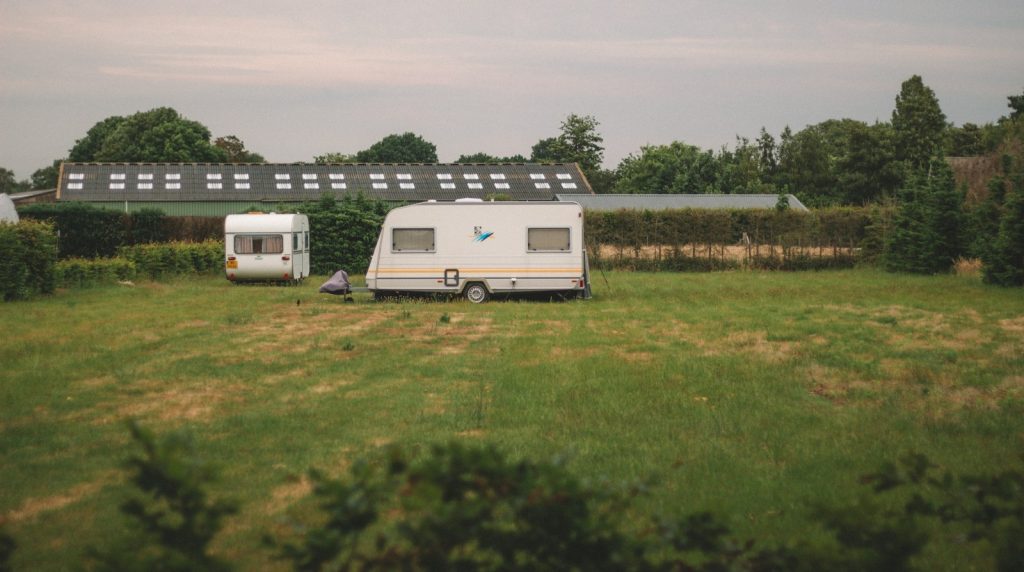
Living in a caravan in the UK on land you own sounds like the simplest route into an off-grid home. This piece is about exactly that: a touring or static caravan sited on your own land as your main home, rather than holiday accommodation.
The catch is that the planning system cares what the land is used for, not what your home is made of. A field with somebody living on it is no longer just a field.
A caravan in the garden of the house you live in is usually fine, while one on a bare field as your main home needs planning permission first.
What Counts as a Caravan
In law, a caravan is a structure designed for living in that can be moved from place to place, by towing or on a lorry, a definition set by the Caravan Sites and Control of Development Act 1960, which applies in England, Wales and Scotland.
A static or twin-unit home stays a caravan as long as it arrives in no more than two sections and, assembled, measures no more than 20 metres long, 6.8 metres wide and 3.05 metres to the ceiling. Those limits come from section 13 of the Caravan Sites Act 1968 and apply in England, Wales and Scotland. Northern Ireland uses the same definition and the same limits, set out in section 15 of the Caravans Act (Northern Ireland) 2011.
Size decides whether it counts as a caravan at all, and how it’s used decides everything after that.
Why Living There Needs Permission
Siting a caravan rarely needs permission in itself. Changing what the land is for does. A paddock is agricultural land, and living on it permanently turns it residential, a material change of use.
It’s a bit like the land having a job description. The field was hired to grow grass. Once somebody sleeps there every night and gets post delivered, it’s doing a different job, and the council gets a say.
That’s true no matter what type of accommodation you choose, across the UK. If you’re new to how planning permission for an off-grid home works in England, start there.
A Caravan Beside Your House
A caravan in the garden of the house you already live in is usually accepted. If your household uses it as extra space, a spare bedroom or a studio, and it relies on the main house for cooking and washing, it’s treated as incidental to the house. That isn’t a change of use, so no planning application is needed, and no site licence either, as the 1960 Act’s First Schedule sets out.
The line is crossed when the caravan becomes a home in its own right. Let it out, or fit it out so it’s independent from the house, and it needs permission like any other dwelling.
The test isn’t who sleeps in it but whether it could stand alone as a separate home.
The Site Licence Layer
Planning permission is only half of it. Under the same 1960 Act, land used as a caravan site in England, Wales and Scotland needs a council site licence, even for one caravan. In Northern Ireland the Caravans Act (Northern Ireland) 1963 requires a site licence from the district council in the same way. In all four nations the licence can’t be issued until planning permission exists, and it sets conditions on spacing, fire safety and drainage.
The exemptions that matter, in all four nations, are the garden caravan above and a single caravan stopping two nights at a time, up to 28 days in any twelve months. Neither works for full-time living.
The Ten-Year Rule
Live somewhere long enough without the council acting and the use can become lawful, with a certificate of lawfulness to prove it. In England the limit is now ten years for every kind of breach, including a change of use to a home. The four-year limit for dwellings went with the Levelling-up and Regeneration Act 2023 for breaches starting on or after 25 April 2024, as GOV.UK explains. Wales and Scotland keep a four-year limit for building work and for turning a building into a home, but a caravan on land usually counts as a change of use of the land, which has a ten-year limit there too. In Northern Ireland the limit is five years for every kind of breach.
Ten years, or five in Northern Ireland, is a long time to live under threat of an enforcement notice, and once one is served the clock stops. It technically protects people who have already lived there for years, but it wasn’t designed to help them. It works more like a cut-off for the council treating the use as a problem than a way in for anyone.
Statics, Seasons and Council Tax
Can you live in a static caravan all year round? On your own land with residential planning permission, yes. On a holiday park, usually not, because the park’s planning permission or licence limits occupation to holiday use. Living in a static on your own plot escapes that. Some parks are set up as residential sites where you can live all year, but you usually have to follow their site rules on things like noise, appearance and the age of the caravan.
Once a caravan is somebody’s sole or main home, the pitch it sits on becomes a dwelling for council tax with its own band, as the Valuation Office Agency’s practice note sets out for England and Wales. In Scotland, the Local Government Finance Act 1992 treats a caravan that is someone’s sole or main residence as a dwelling for council tax too.
Final Thoughts
Whether living in a caravan full time on your own land works depends on the land, not the caravan. A plot within your garden can make it straightforward. A bare field means a planning application, a site licence and a real chance of a no. Buying land and living in a caravan on it, hoping nobody notices, can be an expensive way to find out.
Check before you buy, and learn how land use classes shape the answer before you commit to a site.
Frequently Asked Questions
Does the 28-day rule let you live in a caravan on your land?
No. In England the 28-day rule covers temporary uses of land, and living somewhere isn’t temporary. The 60-day allowance in force since 26 July 2023 applies only to recreational campsites, so neither gives you a home. Wales, Scotland and Northern Ireland have their own 28-day temporary-use rights, and none of them covers a caravan you live in.
Can you live in a caravan while you build a house?
Often, yes. Councils commonly grant temporary permission for a caravan on the plot while a permitted house is built, on condition it goes when the house is finished. It has to be applied for or written into the main permission, so check before the caravan arrives.
What happens if you just move in anyway?
The council can serve an enforcement notice requiring you to stop living there and remove the caravan. Ignoring one after its deadline has passed is a criminal offence in all four UK nations, but it’s aimed at people who carry on after the notice and any appeal, not at someone who has just moved in. Neighbours report more often than you’d think, so applying first is cheaper than arguing afterwards.
Do caravans have to meet building regulations?
No. A caravan within the legal definition isn’t a building, so building regulations don’t normally apply. Statics built for full-time living are made to BS 3632, the residential standard, with far more insulation than a holiday unit, so ask which standard yours was built to.
To find out more about off-grid living return to our Reading Room.