

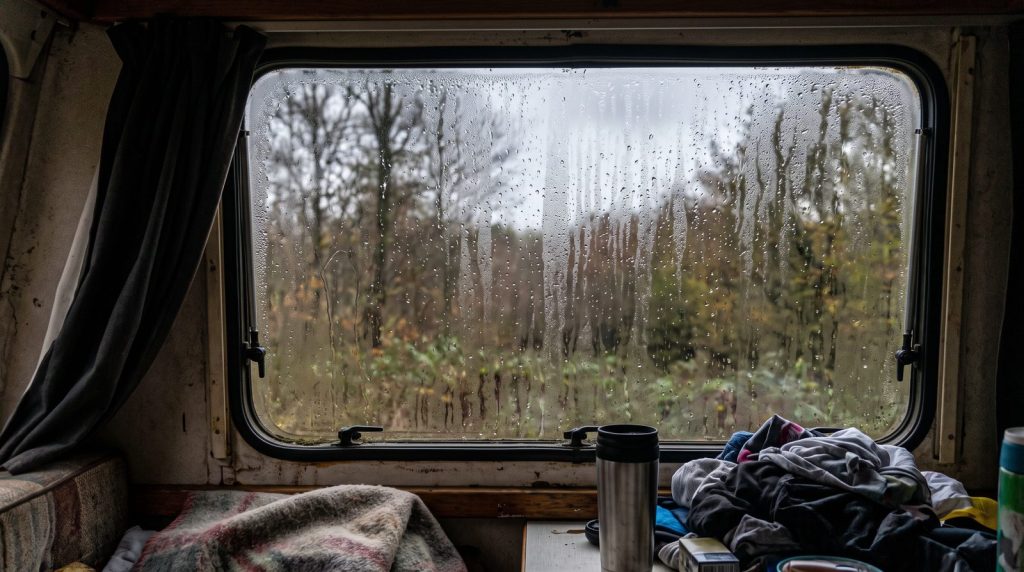
At a Glance
- Condensation is warm, damp air meeting a cold surface, so every fix either dries the air, warms the surface or moves the air outside.
- Flueless gas heaters add water to the air as they burn, while a flued wood burner or a vented diesel heater gives dry heat.
- Ventilation costs you heat, so a 12V heat recovery ventilator is worth a look if your power supply can carry one.
- A cheap hygrometer, a daily airing routine and a few moisture traps do more than most products you can buy.
If you live in a van, on a boat or in a small cabin, damp is the problem that turns up with the first cold week of autumn. Condensation in van conversions shows as wet windows and a damp mattress. On a narrowboat it collects on the steel behind the lining. In a cabin it’s black spots in the corner of a cold wall.
The cause is the same in all three, and so is most of the solution. Where winters are colder or wetter, the same steps matter even more.
Why Small Homes Get Damp
A van, a boat or a cabin is a small, well-sealed space with thin walls and little thermal mass, so it warms fast and cools just as fast. Two people breathing overnight put more than a litre of water into the air, before you’ve cooked or showered.
A house copes through sheer volume and extractor fans. A small home has neither, and it has cold surfaces everywhere: single-glazed windows, steel ribs, a hull in cold water, a timber wall with a gap in the insulation.
Moisture has no way to escape, but plenty of places to hide.
The Dew Point Explained
Warm air holds more water vapour than cold air. Cool it and you reach the dew point, the temperature where the air is full and water drops out as liquid.
Think of a cold can of drink on a warm day. The can isn’t leaking. Warm damp air is meeting a cold surface, and the water on the outside is the dew point at work. Your window at six in the morning is the can.
So there are three basic ways to reduce condensation: dry the air, warm the surface or move the damp air outside.
Condensation in Van Conversions
A van is a steel box, and steel carries heat straight through it. The ribs, window frames and door surrounds are the cold spots.
Insulation warms the inside of the panels so the air touching them stays above the dew point. Thermal window covers matter almost as much, because glass is the coldest and largest surface in the van. Keep a roof vent running on a trickle overnight, and lift the mattress on slats so air can move underneath.
You cannot stop all water vapour being created, but you can keep it from settling on cold surfaces.
Damp in a Narrowboat
Damp in a narrowboat is a special case, because the hull sits in water that’s rarely above a few degrees in winter, so the whole steel shell can sit below the dew point for weeks. Warm air that reaches the steel condenses there, out of sight, and runs into the bilge.
Spray foam bonded to the hull is the standard answer on a modern build, because it leaves no air gap for moisture to reach the steel. A boat also needs fixed ventilation for its fuel-burning appliances, and since 2019 every boat covered by the Boat Safety Scheme has had to carry a working carbon monoxide alarm, so don’t tape up vents to hold in the heat.
On a boat, much of the steel shell stays cold, so managing moisture and airflow throughout the space matters.
Dry Heat Beats Wet Heat
Some heaters dry your home out and some quietly soak it. Any flueless burner that vents into the room, such as a bottled-gas cabinet heater, a paraffin heater or a gas hob, releases the water it makes as it burns. A kilogram of LPG makes roughly a litre and a half of water vapour, which is why a cabinet heater fogs the windows within the hour.
Dry heat comes from anything that sends its exhaust outside: a flued wood burner, or a vented diesel air heater. You get the warmth without the water. If you’re weighing up a diesel heater or LPG, this is one of the strongest arguments, and the same applies to a wood burner in a van.
A flued heater sends combustion moisture outside rather than adding it to the room.
Ventilation Without Losing Heat
You can’t stop making moisture, so the job is to move it outside. The passive kind is free: trickle vents, a roof hatch, two opposite windows cracked open. The catch is that warm air leaves with the damp, so in January you pay for every minute in fuel.
The clever answer is a 12V heat recovery ventilator, which pushes stale air out through a heat exchanger that warms the incoming fresh air. The good ones recover most of the heat on a few watts, so they suit a solar set-up. Whether it’s worth it depends on your power budget in the dark months.
Heat recovery ventilation can remove damp air while retaining some warmth, although it still needs power.
A Daily Routine That Works
There are some products which can help: moisture traps in lockers, anti-condensation paint, thermal blinds. A small desiccant dehumidifier is excellent in a cabin if you can spare the power, and a cheap hygrometer tells you whether any of it is working. Aim for 40 to 60 per cent.
Your habits can make the biggest difference:
- Open two windows for five to ten minutes every morning
- Cook with the lids on and a vent open
- Never dry washing inside without a window or fan running
- Keep furniture and mattresses a few centimetres off outside walls
Together, these daily habits can make more difference than any single product.
Final Thoughts
There isn’t one product that fixes damp, because damp isn’t one problem. It’s warm air, cold surfaces and too little airflow, and which is worst depends on whether you’re in a van, on the water or in a cabin. Work out which aspect matters most for your home and address that first.
Combining heat, insulation and airflow makes damp easier to manage through winter.
If you’re still deciding which kind of small home suits you, you can see what’s on the market in our listings of off-grid homes for sale.
To find out more about off-grid living return to our Reading Room.