At a Glance
- In England a septic tank may only discharge to the ground through a drainage field; running one into a stream or ditch is no longer allowed.
- Discharges to a watercourse must come from a sewage treatment plant, and even then only up to 5 cubic metres a day without a permit.
- Wales and Scotland have their own versions of the rules, with registration required, and other countries have theirs, so check the guidance where you are.
- A reed bed is a treatment stage, not a way round the rules, and the right choice depends on your ground, slope and household size.
If you’re buying or building an off-grid house or cabin on land, sewage is the system nobody wants to think about and the one the regulator cares about most. There’s no mains drain, so what leaves your toilet has to be treated on your plot and released somewhere.
The three ways to do that are a septic tank, a packaged sewage treatment plant, and a reed bed. In England the choice between them is shaped by the General Binding Rules for small sewage discharges. The rules for emptying a composting toilet are a different subject, covered separately.
Treatment is the technical question. Where the water goes afterwards is the legal one.
How a Septic Tank Works
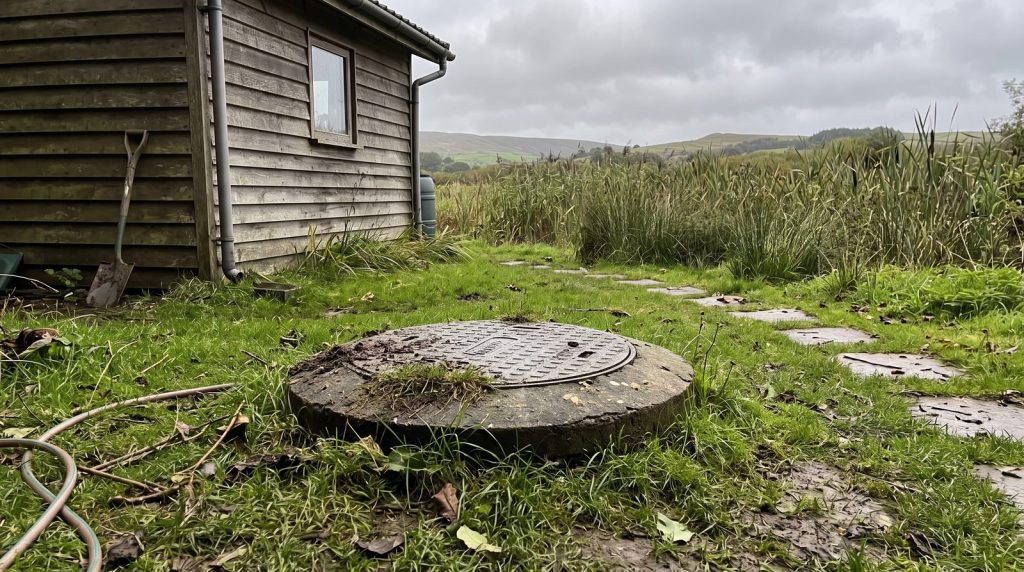
A septic tank is a settling chamber. Waste flows in, solids sink and are slowly broken down by bacteria, while fats and oils float to the surface. The liquid in the middle then flows out to a drainage field, where it passes through a set of perforated pipes laid in gravel trenches and the surrounding soil finishes the treatment.
Think of a jar of muddy water left on a windowsill. Give it time and the mud settles, the water on top clears, but it’s still not clean. That clearer water is what a septic tank releases, and it’s why the ground has to do the rest.
Heavy clay, a high water table or a plot that floods will send the effluent back up the trenches.
A septic tank separates the waste but doesn’t purify it, and the rules are written around that fact.
Treatment Plants and Reed Beds
A packaged sewage treatment plant goes a step further. Air is pumped through the waste so bacteria break it down far more thoroughly, and the water that comes out is clean enough to be released into a watercourse. The catch when you’re living off-grid is your power supply: most plants run a small blower or pump continuously, so they need a reliable electrical supply.
A reed bed is a constructed wetland. Effluent from a septic tank flows through gravel planted with reeds, and the roots and the bacteria around them clean it. It’s silent and needs no power. However, it does need space, a fall across the site, and a proper design. It is a treatment stage after a tank rather than a substitute for one.
Good soakage and a small household point to a tank and drainage field. A plot with no soakage and a stream nearby points to a treatment plant. Space, a gradient and no spare power point to a reed bed.
Your land and off-grid set-up will determine the best option for you.
The General Binding Rules
In England, a small domestic sewage discharge doesn’t need an environmental permit as long as it follows the General Binding Rules. The ones that matter most for an off-grid plot are these (discharges to ground and discharges to surface water, both on GOV.UK):
- A septic tank or treatment plant may discharge to the ground only through a drainage field, and only up to 2 cubic metres a day.
- A discharge to a watercourse must come from a treatment plant, up to 5 cubic metres a day. A septic tank still running to a watercourse must be upgraded, replaced or connected to a drainage field as soon as possible, usually within 12 months.
- New systems must meet the relevant British Standard, BS EN 12566 for tanks and plants and BS 6297 for drainage fields, and be installed to the maker’s instructions.
- Discharges within 50 metres of a private water supply, in a groundwater source protection zone 1, or close to protected sites, need a permit rather than the rules.
- Since 2 October 2023, a new discharge to ground can’t be within 50 metres of another exempt discharge, which can catch two cabins on neighbouring plots.
- The system must be desludged before it overfills, normally at least once a year, and when you sell you must give the buyer a written description of the system and how to maintain it.
Anything outside those limits means a permit application. A small cabin with two people is well inside them; several dwellings sharing a system may not be.
The rules aren’t complicated, but they’re the reason a septic tank alone can’t be the answer on many plots.
Wales, Scotland and Elsewhere
In Wales the same principle applies, and you must register your septic tank or treatment plant with Natural Resources Wales, which is free for most households. A septic tank cannot discharge to surface water there either, and the volume limits for registration are 2,000 litres a day to ground or 5,000 litres to a watercourse from a treatment plant (Natural Resources Wales).
In Scotland you must apply to SEPA for an authorisation to discharge, with most small domestic discharges handled by registration. Since 1 November 2025 that sits under the new EASR regime rather than the older CAR registration, and the registration fee at the time of writing is just under £200 (SEPA). Northern Ireland has its own consent system through the Northern Ireland Environment Agency.
Outside the UK, treat the English rules as an example only: nearly every country regulates where treated sewage can go and how far it must sit from a well or a stream, so find the guidance for your own area first.
Getting It Installed
Whichever system you choose, a new installation in England usually needs building regulations approval, and sometimes planning permission, so check the rules for your area before you dig. A percolation test tells you whether the ground will take a drainage field at all.
Ground conditions make a huge difference to the cost. A straightforward tank and drainage field on a plot with good soakage might be a few thousand pounds; a treatment plant with a long outfall to a watercourse, or a reed bed sized for a family, can be several times that.
Once you know which options are viable, get more than one quote and ask each installer to explain why they have recommended their particular system for your site.
Final Thoughts
Sewage is one of the less obvious costs and practical considerations when buying an off-grid house or plot, but it’s something worth checking before you commit. A property with an old septic tank running into the stream isn’t a disaster, but it’s a cost that belongs in the negotiation rather than the first winter.
Understand where the water can legally go on your plot, match the system to the ground, and the rest is engineering. Our older overview of off-grid waste management covers the wider picture, from composting to recycling.
To find out more about off-grid living return to our Reading Room.