

At a Glance
- A restrictive covenant on land can stop you building, living or even parking a caravan there, whatever the planning position says.
- Legal access matters as much as planning: a plot with no right of way to a public road can be close to worthless.
- Ransom strips, shared tracks and public footpaths all change what you can do with a plot and what it is really worth.
- In England and Wales the title register costs £7 and shows most of this, so read it before you fall for a plot.
If you’re considering buying land to live on off-grid, planning permission tends to get all the attention. It deserves it, but there’s a second layer of small print that catches out just as many buyers, and it involves the title deeds, not council policy.
Covenants, easements, rights of way and access are what decide whether you can actually use a plot the way you’re imagining. They’re also the things an estate agent’s listing tends to skate over. This piece covers that side of buying a plot only: the planning question is dealt with in our guides to land use classes and planning potential.
Planning looks at what development may be permitted. The title and associated documents contain covenants, easements and rights that affect how you can use the land.
What a Restrictive Covenant Is
A restrictive covenant is a promise written into the deeds that limits what can be done with the land. It might say no building, no residential use, no caravans or mobile homes, no business, or no more than one dwelling.
The important thing is that the promise attaches to the land, not the person who made it. Think of it like a house rule written into the building itself rather than the tenancy: every new owner inherits it. Searching for any restrictive covenants on a potential piece of land is worth doing early because a covenant against residential use can undo an otherwise perfect plot, even one where planning permission might be winnable.
Reading the Title Register
In England and Wales, anyone can buy a copy of the title register and title plan from HM Land Registry for £7 each (GOV.UK). The register lists the owner, any mortgage, and details of restrictive covenants and easements, though sometimes it only refers you to an older deed, which you then need to get hold of as well.
Scotland runs a different system through Registers of Scotland, where the equivalent of a covenant is a real burden. Northern Ireland has its own Land Registry. If you’re reading this from outside the UK, the principle still holds: find the public record of what’s attached to the land and read it before you spend anything.
Seven pounds and an evening’s reading can save you the price of the plot.
Getting to Your Plot
A surprising number of rural plots don’t touch a public road. The only way in is over somebody else’s land, and your right to use that route is an easement, usually called a right of way in the deeds. If there’s no easement, or it only permits access on foot or for agricultural purposes, you may not legally be able to drive a van, a delivery lorry or a digger to your own land.
Look for the wording. A right of way “at all times and for all purposes” is what you want. One “for agricultural purposes only” is a problem the moment you try to live there. Check who maintains the track, whether the right is shared, and whether a gate can be locked against you.
A plot may look great on a map, but unexpected restrictions might lead to real problems.
Ransom Strips Explained
A ransom strip is a sliver of land, sometimes less than a metre wide, that sits between your plot and the road or the mains. Whoever owns it controls your access, and they can name their price for letting you cross it. It’s like someone else owning the only doorway into a room: the room might be yours, but you’re paying to walk through the door.
The title plan is where you spot them. Compare the red edge on the plan with the road, and if there’s a gap, find out who owns it and whether you have a right over it.
A cheap plot behind a ransom strip is rarely cheap by the time you’ve bought your way out.
Public Rights of Way
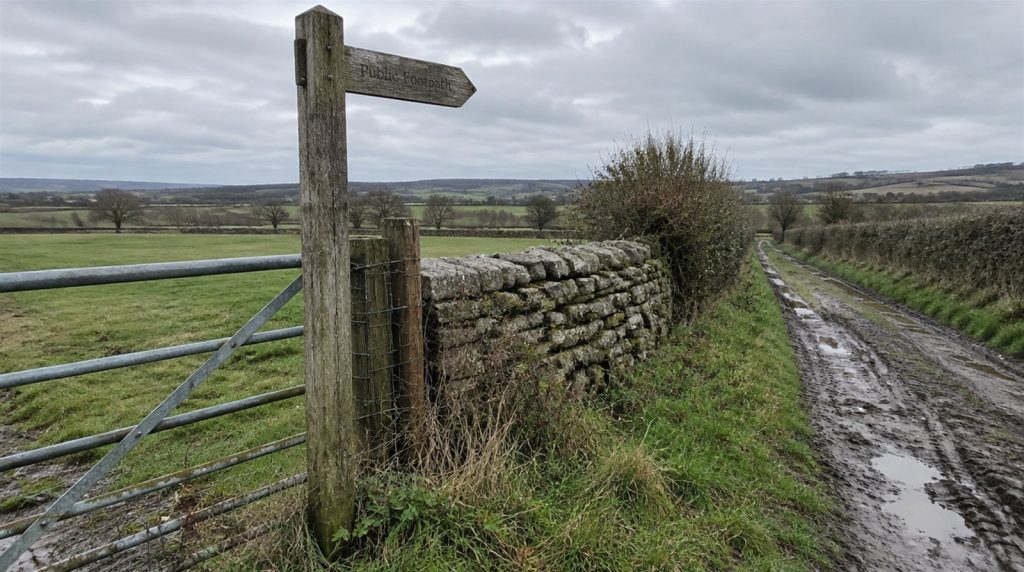
The reverse problem is other people’s rights over your land. In England, footpaths, bridleways and byways are recorded on the definitive map held by your local authority, and once recorded they are public highways. Obstructing a public right of way is a criminal offence, and you must keep the route visible, unobstructed and free of locked gates, fences or barbed wire across it (GOV.UK landowner guidance). Wales, Scotland and Northern Ireland each have their own rules and, in Scotland, wider access rights, so check the guidance for the nation you’re buying in.
Plenty of people live happily with a footpath along the field edge, but a bridleway through the middle of a two-acre plot shapes where you can put a cabin, a polytunnel or a fence, and diverting one means an application to the council with no promise of success.
Living With or Removing Covenants
Old covenants aren’t always enforceable. The person with the benefit may be untraceable, or the covenant may have been drafted so loosely that it no longer stands. In England and Wales you can also apply to the Upper Tribunal (Lands Chamber) to have a restrictive covenant discharged or modified, on grounds that include it being obsolete or impeding a reasonable use of the land (GOV.UK tribunal guidance). It’s slow, it can involve compensation, and it doesn’t cover easements or rights of way at all.
A covenant against building on a plot you only want to graze and camp on may be irrelevant. The same covenant on a plot you’re hoping to build a cabin on is the whole story. Decide what you actually want to do there, then read every restriction against that plan rather than in the abstract.
The question isn’t whether a plot has restrictions – nearly all do. The real question is whether those restrictions stop what you want to do.
Final Thoughts
Buying land to live on off-grid is exciting, and a beautiful field with a hopeful price is hard to walk away from. The buyers who come unstuck are almost always the ones who checked planning and stopped there.
Before you commit, read the title, trace the access to a public road, look for the gap that could be a ransom strip, and walk any path that crosses the land. Then take it all to a solicitor who knows rural property. The listing describes the view; the title gives you the full picture.
If you’d like help finding a plot in the first place, our Off-Grid Home Research Service does the initial research for you and puts together a shortlist of the best options, based on the information available. It doesn’t cover title plans or planning information, so everything above is still for you and your solicitor to check before you commit.
To find out more about off-grid living return to our Reading Room.