

At a Glance
- A cheap Chinese diesel heater can be safe. The risk is nearly always in the fitting, not the heater itself.
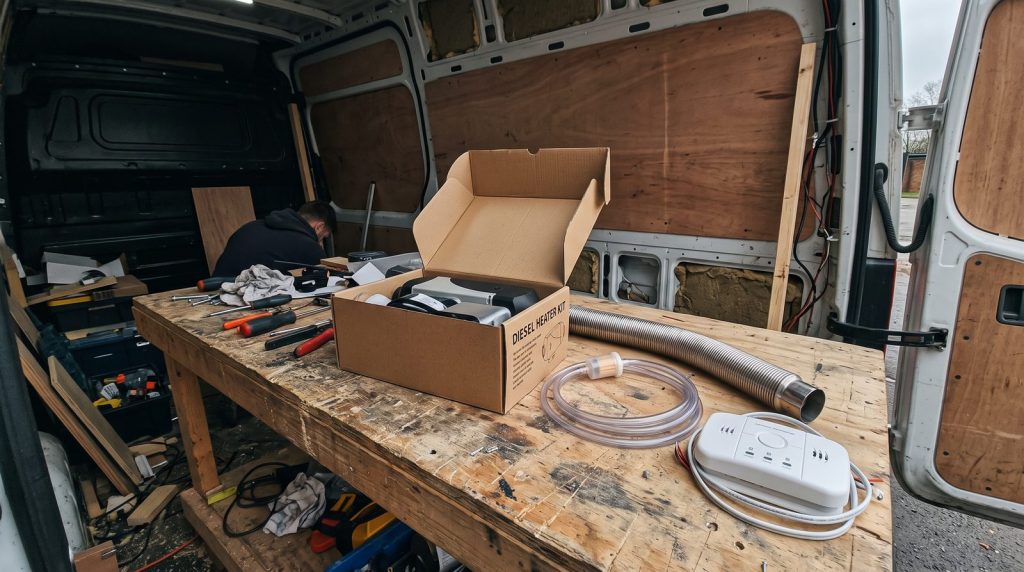
- The four things that matter are a gas-tight exhaust that ends outside, a sound fuel line, a proper air intake and a carbon monoxide alarm.
- Vevor, Hcalory and the unbranded 5kW and 8kW units are all the same basic design, so the checks are the same whichever you buy.
- On most UK inland waterways the Boat Safety Scheme will examine a boat’s installation. In a van or cabin the standard is usually the one you set for yourself.
If you’re fitting out a van, a truck, a boat or a small cabin, you’ve almost certainly seen a Chinese diesel heater for a fraction of the price of a Webasto or an Eberspächer.
The obvious question is whether something that cheap can be trusted to burn fuel a metre from your bed.
The honest answer is that most of them work, and most of the problems people have with them are installation problems.
There’s a middle ground too. Autoterm, sold for years as Planar, sits between the cheap kits and the big two on price, and it’s the one to look at if the bottom of the market makes you uneasy.
The diesel heater or LPG decision is covered separately. This piece assumes you’ve chosen diesel and are looking at the cheap end of the market.
Whether it’s safe depends on what you check before you turn it on, and each of those checks is covered below.
What a Chinese Diesel Heater Is
Vevor, Hcalory, the all-in-one suitcase units and the bare kits sold on marketplaces are close cousins. Each has a metal combustion chamber, a glow plug, a ticking fuel pump, a fan and a control panel.
The design copies the European originals, which is why it works, and the cost saving comes from thinner metal, looser tolerances and sparse instructions.
The kW figure on the box is optimistic. An “8kW” unit rarely delivers that, and a 2kW or 5kW unit is plenty for a van or a small boat.
Bigger isn’t better in a small space, because a heater that’s always on its lowest setting soots up.
Treat the box as a kit of parts rather than a finished appliance, because it’s how you fit it that makes it safe.
The Exhaust Is Everything
The exhaust matters more than any other part, because a leak there can put carbon monoxide into the space you’re breathing. The combustion gases are the same as a car’s, and the pipe that carries them out is the weak point on a cheap kit.
The supplied exhaust is usually a thin flexible pipe and a small silencer made for the underside of a truck. On a boat that’s a real hazard.
Road vehicle silencers often have a drain hole and aren’t gas tight, so on a boat they can leak carbon monoxide into the hull. The Boat Safety Scheme requires every joint in the exhaust, silencer included, to be gas tight, so use a marine exhaust and a proper through-hull fitting instead.
In a van the principle is the same.
The exhaust must be sealed at every joint, run downhill so condensate drains out rather than back into the heater, end well away from windows, vents and the air intake, and be lagged or shielded wherever it passes near anything that can melt or burn.
Once it’s running, check the joints now and then for soot, because soot around a joint is a sign it isn’t gas tight.
Fuel Line and Tank
The thin white nylon fuel line in the kit is fine if it’s run properly. Keep it away from heat, support it so it can’t chafe, and fit the pump at the angle the instructions show so it doesn’t fill with air.
The joints are where fuel weeps. Use the correct short rubber connectors and clips, not pushed-together pipe.
On a boat, Boat Safety Scheme examiners look for fuel pipes above bilge water and a sound tank, and they’ll currently accept a small purpose-made plastic tank of up to ten litres for a diesel heater, provided it looks like proper proprietary kit rather than an improvisation.
Drawing from the main tank on a vehicle or boat is neater and means one fuel, but it needs a proper standpipe fitting rather than a hole drilled in a hose.
Diesel isn’t explosive like petrol, but a leak in a warm locker is still a real fire risk, so check the fuel joints for weeping every so often.
Air Intake and Ducting
The combustion side of the heater needs its own fresh air intake from outside, and it must never share space with the exhaust outlet. If the intake can breathe exhaust, the heater won’t get the clean air it needs, and it will burn badly and soot up.
The warm air side is separate. It pulls cabin air over the hot chamber and out through ducting, and that air never touches the flame. Keep the ducting clear of bedding and stored gear, because the outlet gets hot enough to scorch.
Keep the exhaust well away from the warm air intake as well, because a leak close to it can blow carbon monoxide straight into the cabin.
The Carbon Monoxide Alarm
This is the part that doesn’t depend on your skill. Whatever you’ve fitted and however carefully, put a carbon monoxide alarm within earshot of where you sleep.
Alarms certified to BS EN 50291-2 are made and tested for vehicles and boats, where vibration and damp are harder on ordinary household units.
On most UK inland waterways the Boat Safety Scheme has required a working CO alarm on boats with cabins since April 2019, and examiners check heater installations every four years. In a van or cabin there’s usually nobody to check, which is exactly why you should.
Test the alarm regularly and never take its batteries out, because it’s the one thing that will warn you if the heater does go wrong.
Priming and First Start
Priming a Chinese diesel heater means pumping fuel through the empty line until it reaches the chamber. The instructions are usually poor, so it’s worth watching a demonstration for your exact controller before you start.
Do the first run outdoors or with every door open. A new unit smokes as the coatings burn off, and the first few starts show up any leaks in the fuel line and exhaust while you’re paying attention.
Run it hard now and then. A heater kept on its lowest setting builds soot, and a sooty heater smokes and shuts down.
Final Thoughts
A cheap diesel heater isn’t a dangerous product so much as an unfinished one. The heater in the box is usually fine. The exhaust in the box usually isn’t, and the instructions leave you to work out the rest.
Fit a sealed marine-grade exhaust, run the fuel line properly, keep the intake and exhaust apart, and put a CO alarm where you sleep. Do those four things and a cheap diesel heater will keep a van or boat warm for years.
To find out more about off-grid living return to our Reading Room.