

At a Glance
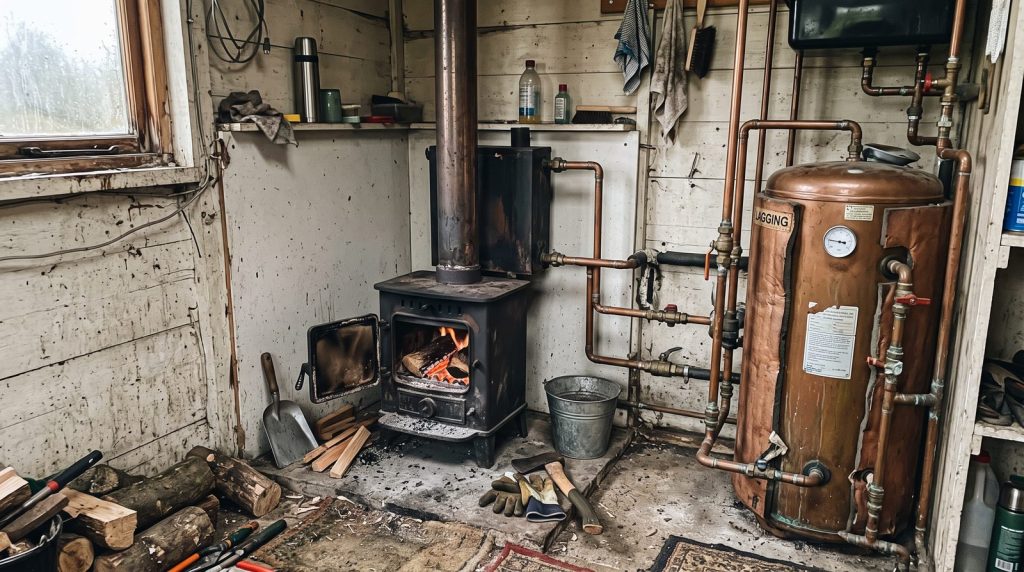
- A back boiler is a water jacket inside or behind your wood stove. The fire heats it, and the hot water rises to a cylinder or radiators.
- A correctly designed gravity circuit can circulate hot water without a pump, but some back-boiler systems need a pump.
- The system must be open vented. A sealed solid fuel boiler with nowhere for steam to go is an explosion risk, and the HSE has said so.
- In a house or cabin it wants a HETAS installer or Building Control sign-off. On a boat it comes under the Boat Safety Scheme.
If you already heat a house, a cabin or a boat with a wood burning stove, you’re burning the fuel anyway. A wood burning stove with a back boiler lets the same fire heat your water, which is why it’s the winter workhorse of so many off-grid homes.
The overview of hot water options is in How Do I Get Hot Water Off-Grid?. This piece goes deeper on the one option that runs off the stove you already have, and on the safety rule that comes with it.
Whether a back boiler suits you depends on your stove, your layout and how much hot water you use. Here’s how it works and how to decide.
Back Boiler Wood Burning Stove Basics
A back boiler is a steel or stainless steel water jacket built into the stove, either as a plate on the back wall of the firebox or wrapping around the sides.
Water flows in at the bottom, picks up heat from the fire, and leaves at the top.
Some wood burning stoves are sold with a boiler already fitted. Others accept a clip-in boiler kit that replaces the back firebrick.
A stove with a boiler gives a bit less heat to the room, because part of the fire’s output has gone into the water, so a boiler stove is often rated slightly larger than a room-only stove of the same size.
The boiler is part of the stove and heats water using the same fire.
How Gravity Circulation Works
Some back-boiler systems can circulate water by gravity, without a pump. Hot water is lighter than cold water, so it rises out of the boiler, up a pipe to the hot water cylinder, gives up its heat, and sinks back down a return pipe to the stove.
With the fire lit and the pipework designed for gravity circulation, water can keep moving without a pump.
Think of it like a lava lamp. Warm the bottom and the contents rise on their own, cool at the top and fall again, with nothing driving it but heat.
For gravity to work, the cylinder has to sit above the stove, ideally a metre or more higher, and the pipes have to rise continuously with no dips for air to collect in.
The flow and return are usually 28mm copper for a short run, and larger if the run is long. In a boat, where the cylinder can’t go up a floor, the pipe run is kept short and the cylinder sits as high as the boat allows, or a small pump is added.
No pump means it works without relying on electricity. That is especially useful in an off-grid home.
Why It Must Be Open Vented
This is the rule that matters, and it’s the one people get wrong when they improvise.
A wood fire can’t be switched off. If the water in the boiler has nowhere to go when it boils, pressure builds inside a sealed steel box next to a fire.
The Health and Safety Executive issued a safety alert after a run of incidents where redundant back boilers, left sealed and then heated by a fire, exploded, with serious injuries and one death.
A properly designed open-vented system has a feed-and-expansion tank and a vent pipe routed safely so boiling water and steam can discharge without pressurising the boiler. That’s what ‘open vented’ means.
A solid fuel circuit is never connected directly to a sealed or pressurised heating system without proper hydraulic separation and a safety design by someone who does this for a living.
There’s a second rule that follows from the first: if you buy a house or cabin with an old back boiler behind a fireplace, don’t light a fire in front of it until someone has checked it’s either connected and vented or removed altogether.
An open vent gives steam a way to escape if the water boils, which is why a sealed, disconnected back boiler is dangerous.
Sizing and Layout
A stove back boiler produces anything from around 1kW to 8kW or more of heat to the water, depending on the stove, and the cylinder it feeds is usually between about 80 and 200 litres. A couple in a cabin who shower once a day are at the small end.
A family in a house running radiators as well as a cylinder are at the top, and may want a larger boiler stove or a second heat source for the water in summer.
That last point matters. A back boiler only makes hot water when the fire is lit, and nobody lights a stove in July.
Most off-grid homes pair it with something for the warmer months, and a twin coil cylinder lets the stove and a summer source share the same tank.
In a boat the back boiler often feeds a calorifier and one or two radiators along the cabin, which is an efficient way of spreading the stove’s heat down a long, thin space.
Choose the boiler’s water-heating output to match your needs, not just the stove’s nominal size.
Who Fits It and Who Checks It
In England, fitting a stove with a back boiler is controlled work under the Building Regulations. Approved Document J covers the appliance, flue and hearth, and the water side has to be designed and installed safely.
A HETAS registered installer can self-certify the job, otherwise it goes through Building Control. Wales, Scotland and Northern Ireland have their own building regulations, so check the version that applies to you.
On a boat, the stove and its flue come under the Boat Safety Scheme’s solid fuel stove advice, and a carbon monoxide alarm has been a requirement for a BSS certificate since 2019.
The open vent rule is just as important afloat, arguably more so, because the cylinder is closer to the fire.
Outside the UK the physics is identical, so the open vent principle travels. Check the installation rules where you are before anyone lights the stove.
This is a safety-critical system, so use an experienced installer for the design and any required sign-off.
Final Thoughts
A back boiler uses heat from a stove you already run and, with correctly designed gravity circulation, can heat water without electricity.
Get the cylinder above the stove, keep the pipes rising, fit an open vent and a header tank, and pair it with something for summer.
If you’re choosing the stove first, the piece on what size wood burner you need covers the room side of the sums.
Choose an installer with experience of solid-fuel hot-water systems in your type of home.
To find out more about off-grid living return to our Reading Room.