

At a Glance
- Many UK off-grid houses and cabins keep a backup for the still, grey weeks of winter, but a boat or vehicle can also charge from its engine’s alternator, and plenty carry a generator as well.
- Size the generator for your battery charger and the biggest thing you’ll run at the same time, not for the whole home.
- A 2 to 3.5kW inverter generator covers most charging jobs quietly and cleanly, while a larger open-frame diesel suits long daily running.
- A generator should only be run outside, and in Great Britain red diesel is allowed for home electricity generation while petrol storage above 30 litres must be notified.
If you live off-grid in a house or cabin, on a boat or in a vehicle, solar does most of the work for most of the year. The question is what happens in the fortnight in December when the panels barely register, and whether that means buying an inverter generator or finding another way through.
A house or cabin will usually want a generator, while a boat or vehicle can often charge from its engine instead, though plenty of boats and vehicles carry a backup generator as well. Whether you can manage without one depends on how much power you use, how much battery you’ve got, and how much of a compromise you’re willing to make on power usage.
Why Solar Still Needs Backup
A panel in December makes a fraction of its June output, and a still, overcast week can push that close to nothing. Batteries can last for a few days, then something has to put charge back in.
For a fixed home, the usual answer is a generator to back up the solar, because it does one job well: it fills the batteries in a few hours, then goes quiet until the next grey spell.
When You Can Skip It
Plenty of set-ups run without one. If your daily use is small, your battery holds several days, and you can put up with a week of lamps and no washing machine, you may never miss it.
On a boat or in a vehicle the answer is usually already on board. The alternator charges the batteries whenever the engine runs, so cruising, or an hour of engine at the mooring, does what a generator would, and many liveaboards never buy one.
What Size Generator You Need
The right size of backup generator is worked out from two numbers, and neither is the size of your house.
The first is what your battery charger can accept. A charger putting 50 amps into a 24-volt battery bank draws about 1.5kW, so a 6kW machine would be wasted on it. The second is the largest load you’ll run while charging, such as a water pump or a small power tool. Add the two together, then multiply the total by 1.25 to allow a quarter extra for starting surges and cold weather, and that’s your size.
Say your charger draws 1.5kW and the biggest thing you’ll run alongside it is a 1kW power tool.
1.5kW + 1kW = 2.5kW, then multiply 2.5kW by 1.25 to get about 3.1kW.
So a generator rated at around 3kW is the right size for that set-up. For most cabins and small houses the sum lands between 2 and 3.5kW. A large house running heavy loads straight off the generator might need 5 to 8kW, but at that point it’s the main power supply rather than a backup.
Choosing an Inverter Generator
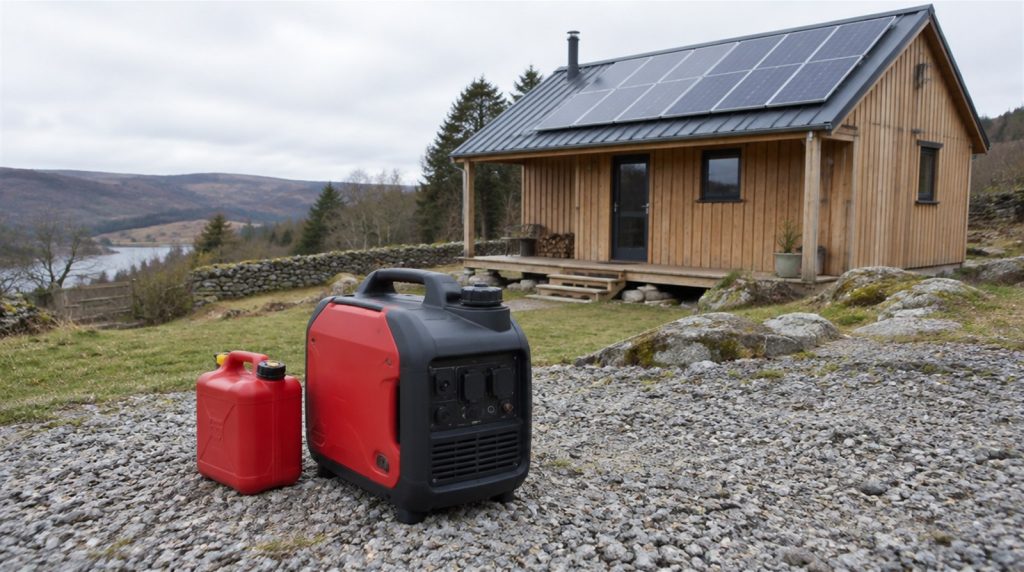
An inverter generator turns the engine’s rough output into clean, stable electricity, throttles down when the load is light, and is far quieter than an open-frame machine, which is what you want for charging batteries. Most are petrol, portable and in the 1 to 4kW band, from makes such as Honda and Hyundai.
A portable power station sold as a battery inverter generator is really a battery in a box, so it can store solar power but can’t make any of its own in a grey week.
An open-frame diesel generator suits a different job. It’s heavier, louder and cheaper per kilowatt, plus it’s built to run for hours a day. If you’ll run it most winter evenings, a diesel generator will outlast a small petrol machine and cost less to fuel.
Petrol or Diesel
Petrol machines are lighter and cheaper to buy. The catch is storage. In Great Britain you can keep up to 30 litres of petrol at home without telling anyone, but above that, up to 275 litres, you must notify your local petroleum enforcement authority in writing under the Petroleum (Consolidation) Regulations 2014. Petrol also goes stale within months, so a generator that sits all summer can refuse to start in November.
Diesel keeps longer than petrol, often for up to a year, and a diesel generator sips it. Since April 2022 most uses of red diesel have been stopped, but HMRC’s guidance on rebated fuels still allows it for generating heat and electricity for premises not used commercially, which includes your home, provided three quarters or more of the output is non-commercial. On a boat in Great Britain a private pleasure craft can only use red diesel if you declare how much is for propulsion and pay full duty on that share, and a generator sharing the engine’s tank falls under the same rule. The exception is a boat that is your permanent home on a residential mooring, where HMRC lets you buy all your fuel at the rebated rate if you can show proof such as a residential mooring licence or a council tax bill for the mooring. Northern Ireland differs, so check for your own area.
Fuel is the running cost you’ll live with for years, so it’s worth deciding between petrol and diesel before you choose the machine.
Running It Safely
A generator produces carbon monoxide, which kills people every year. It should only be run outside, never in a building, vehicle or tent, with the exhaust pointing away from doors, windows and vents, and a CO alarm inside regardless. On a boat the exhaust needs the same care, and the Boat Safety Scheme has required a carbon monoxide alarm since 2019.
Noise is the other thing. On Canal & River Trust (CRT) waters the licence conditions say no engine or generator between 8pm and 8am unless you’re moored well away from anyone, as the CRT’s silent nights note explains.
Final Thoughts
Whether you need a generator with your solar comes down to your winter, your battery and your tolerance for going without. A house or cabin in the UK usually wants one for a handful of grey weeks, while a boat or vehicle has the alternator to fall back on, with or without a generator as well.
The aim is a generator that keeps your batteries topped up through December, rather than one big enough to run the whole house.
For the solar side of the sum, our guide to off-grid solar systems covers the parts and how to size them.
If your home is a boat or a live-in vehicle and you’d rather have the whole system installed as one, off-grid electrical fitters are listed in our Business Catalogue.
To find out more about off-grid living return to our Reading Room.