

At a Glance
- Micro hydro turns the drop and flow of a stream into electricity, and unlike solar it keeps going all night and all winter.
- A modest stream with a 10 metre drop can give a home around 1kW continuously, which is more energy per day than most off-grid solar arrays.
- Almost every scheme in the UK needs permission from the environment regulator for taking and returning the water, and usually planning permission too.
- Expect anything from a few thousand pounds for a tiny kit to £40,000 or more for a few kilowatts installed, with civil works the biggest cost.
This piece is for anyone buying or already living on a property with a stream running through it, whether that’s a house, a smallholding or a bare plot you plan to build on. Micro hydro is the off-grid power source hardly anyone talks about, because hardly anyone has the water for it. If you do, it changes the whole energy picture.
The appeal is simple. Solar sleeps at night and dozes through December. Wind comes and goes. A stream runs whether you’re watching it or not.
What Micro Hydro Actually Is
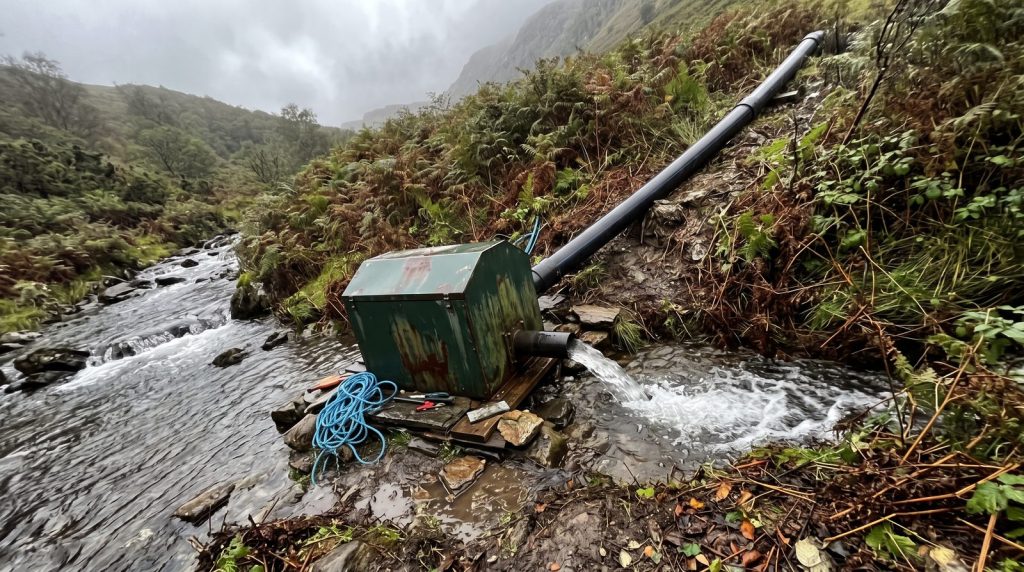
A micro hydro system takes some of the water out of a stream at a high point, runs it down a pipe to a turbine at a lower point, and returns it to the same stream a little further along. The turbine spins a generator, and the electricity goes to your batteries or straight to the house.
Micro means small, schemes under 100kW in the industry’s language, and for a home usually somewhere between 500 watts and 10kW. Nothing about it is exotic. The pipe is plastic, the turbine is the size of a dustbin, and the hardest part is digging the trench.
In principle, it works like a water wheel, just with better engineering.
Head and Flow Decide Everything
Two numbers tell you whether micro hydro power is worth it on your land. Head is the vertical drop between where you take the water and where you return it. Flow is how much water passes, measured in litres per second.
Think of a tap fed by a water tank above it. The higher the tank, the harder the water comes out, and that’s head. Now think of the difference between a garden tap and a fire hydrant, and that’s flow. You need some of both, but a lot of one can make up for a little of the other.
The sum is straightforward:
kilowatts of power = flow x head x gravity x kit efficiency
To get a rough figure in kilowatts, multiply the flow in cubic metres per second by the head in metres, then by 9.81 for gravity, then by the efficiency of the kit, which for a small system is often around 50 to 70%. The British Hydropower Association walks through it on its page for people thinking of installing hydro.
Measure both across a year before you spend anything. A stream in February and the same stream in August can give completely different results.
What a Small Stream Gives You
Put some numbers in and the picture sharpens. A stream dropping 10 metres and running at 20 litres a second gives you roughly 1kW after losses. That sounds tiny next to a 4kW solar array until you remember it runs 24 hours a day, so it delivers around 24kWh every day, in December as much as June.
Most off-grid homes use less than that. A steeper stream with 50 metres of head needs only a trickle for the same output, and a flat one with 2 metres needs a larger volume of water.
That’s why micro hydro generation in the UK is focused in Wales, the Lake District, the Pennines and the Highlands, where the ground falls steeply and the rain keeps coming. A lowland brook rarely has the drop, though a mill leat with an old weir is sometimes the exception.
Turbines for Different Sites
Your turbine choice is dependent on the site. High head with low flow suits a Pelton or Turgo wheel, which fires a jet of water at cups on a spinning wheel. Medium head suits a crossflow turbine. Very low head with plenty of water suits an Archimedes screw or a modern water wheel, which is why you see screws at old mills.
The intake screen matters as much as the turbine. It keeps leaves, gravel and fish out of the pipe, and a blocked screen is the usual reason a small scheme stops making power, so build it where you can clear it in wellies.
The Permissions You Need
Here the law does matter, because you’re taking water out of a stream and putting a structure in it, and that’s the reason to check what the regulator needs before you buy a turbine.
In England the Environment Agency handles it. Taking water needs an abstraction licence above 20 cubic metres a day, which a hydro scheme passes easily, and building or altering a weir or dam needs an impounding licence regardless of size. Work in or next to the watercourse may also need a flood risk activity permit, and the Agency expects fish and eel screening on the intake.
Its guide to applying for a new hydropower scheme lists all of them and offers pre-application advice, and it’s blunt that new weirs on lowland rivers are unlikely to be approved.
In Scotland every hydro scheme, however small, needs authorisation from SEPA for the abstraction and any intake or weir. In Wales, Natural Resources Wales plays the same role. Wherever you are, planning permission is usually needed for the turbine house and pipe, so apply for both at the same time. Outside the UK, the same basic principle usually applies: you will generally need approval from both the authority responsible for water resources and the local planning authority.
What It Costs
Micro hydro is expensive to build but cheap to run. The British Hydropower Association’s rough guide is around £8,000 per kilowatt for a small scheme and nearer £4,000 per kilowatt for a larger high-head one. It notes that about 70% of the cost of a typical UK scheme is civil works: the intake, the trench and the turbine house.
So a tiny pico system you install yourself on a steep stream might come in at a few thousand pounds, while a 3 to 5kW scheme with licences, professional design and a proper intake often lands somewhere between £20,000 and £40,000, and more on a difficult site. What you get for that is a generator that can run for decades with a bearing change and a clean screen.
Final Thoughts
A micro hydro system in a stream could power your home, but it depends on some numbers. Measure the head with a level and a tape, measure the flow with a bucket and a stopwatch, and do it in a dry month as well as a wet one. If the sum gives you a few hundred watts continuously, micro hydro is worth a proper look, because those watts arrive at night. If it gives you a few dozen, a small wind turbine or more solar will serve you better.
On the right stream, with enough head and flow all year round, micro hydro can be the most dependable power an off-grid home can have.
If a stream is on your wish list, the head and flow are the first things to ask about when you look at a property, and you can browse the current off-grid homes for sale on Homes Off Grid.
To find out more about off-grid living return to our Reading Room.