

At a Glance
- A polytunnel gives you the most covered growing space per pound, which is why smallholders choose it over glass.
- Wind is what kills polytunnels, so how it’s anchored matters more than the make or the cover.
- You can keep frost off crops without mains power using thermal mass, fleece and an inner skin.
- In most gardens a polytunnel needs no planning permission, but farmland and protected land come under different rules.
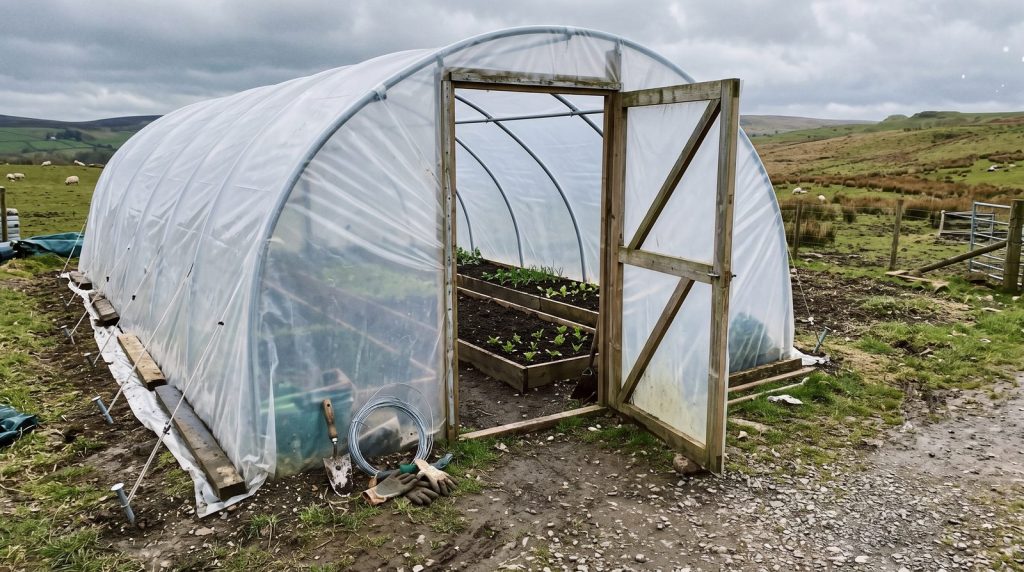
If you’re planning to grow a serious share of your own food on a smallholding or in a big garden, a polytunnel in the UK climate is the single biggest step up you can make. This piece is about polytunnels on land you’re growing on, whether that’s a plot behind an off-grid house or a field you’ve bought to work.
The retailers will happily sell you a polytunnel. What they don’t tell you is how to stop it leaving in a January gale, or how to keep it above freezing when there’s no socket within a mile.
Which tunnel you choose, and how you fix it down, depends mostly on how exposed your site is.
Polytunnel or Greenhouse
The polytunnel or greenhouse question is mostly about money and space. Glass lets in a little more light and looks better, but for the same spend a polytunnel covers several times the area. On a smallholding, where you want beds you can walk between and a wheelbarrow down the middle, that’s what matters.
Polythene also softens the light, which suits leafy crops and seedlings, and it’s easier to replace once it becomes brittle or damaged, which it will after somewhere between five and ten years depending on the grade.
When choosing a polytunnel, look at the width, hoop spacing and steel gauge rather than just the headline price.
Glass suits smaller spaces where appearance matters. For a larger working growing area, polythene is usually the more practical choice.
Sizing for Year-Round Growing
When choosing a polytunnel for UK use, think about what you want to grow and how you’ll use the space throughout the year. A wider tunnel gives you more room for growing beds, paths, shelving and working space, while extra height makes it easier to stand and work comfortably.
Allow space for water storage, potting, and somewhere to keep tools or supplies. You may also want room for crops at different stages rather than filling every available metre with planting beds.
Two doors, one at each end, are useful for ventilation in summer and make it much easier to move wheelbarrows, materials and larger plants in and out. Think about the practicalities before you decide on the dimensions, including where the tunnel will sit, how you’ll anchor it and how much space you realistically have available.
The biggest polytunnel isn’t necessarily the best one. Choose a size you can use properly, maintain and keep productive rather than paying for space that ends up sitting empty.
Anchoring Against the Wind
A polytunnel is like a sail. In a gale the cover tries to lift the whole structure, so the job of the anchors is to hold it down as much as to stop it sliding. On a sheltered plot, the foundation tubes that come with a kit, driven well into the ground, do the job. On an open site you want more: a ground anchor plate on each tube, or the tubes set in concrete, and a base rail so the cover is fixed to the frame rather than only buried in a trench.
Fit the cover on a warm, still day and pull it drum tight, because a loose cover flaps, and flapping is what tears it. Add crop bars and diagonal bracing on the end hoops, and site the tunnel end-on to the prevailing wind rather than side-on where you can.
On a truly exposed site, look at the polycarbonate-clad designs. The best known is the Polycrub, designed by the community in Northmavine, Shetland, one of the windiest places in the UK, and built from recycled salmon-farm pipe to survive the weather there. If it was drawn up for a Shetland winter, it’ll cope with most other places.
The cover is the cheap part, the anchoring is what you’re really buying.
Planning and Site Rules
In most gardens a polytunnel is treated as an outbuilding, and you can put one up without planning permission provided it’s a sensible size, sits behind the front of the house and doesn’t cover more than half the garden. That’s the position in England, set out on the Planning Portal, and Wales and Scotland have similar rules of their own. National parks, conservation areas and listed buildings are stricter everywhere.
On farmland it’s a different system. In England, a holding of five hectares or more can put up agricultural buildings under permitted development, which can include a polytunnel, but you’ll usually need to notify the council first, and smaller holdings don’t get the same rights. Wherever you are, check the local planning rules before you order.
Heating It Without Mains
You don’t need to heat a polytunnel, you just need to stop it dropping below freezing, which is a much smaller job.
Thermal mass does most of the work. Black water butts, barrels or even bottles lined along the north side soak up warmth all day and give it back overnight, and a few hundred litres will lift the coldest hours by a degree or two. Line the inside with bubble insulation for the winter months to trap a layer of still air, and put fleece or cloches over the beds inside the tunnel, so the vulnerable crops have two skins between them and the frost.
Compost heat is real too. A fresh heap of manure or grass clippings inside the tunnel gives off warmth for weeks as it breaks down.
If you do want an active heater, a paraffin heater on the worst nights is a popular off-grid choice. It adds moisture to the air, so vent the tunnel in the morning, and never sleep in a tunnel with one burning. A diesel heater is another great option.
Keeping It Alive in Summer
The same tunnel that saves your crops in April will cook them in July. Open both doors every morning, fit side vents or roll-up sides if the kit offers them, and shade the roof with netting in the hottest weeks.
Water is the biggest summer challenge. A polytunnel sheds a huge amount of rain off its own roof, so gutter kits feeding a butt at each corner give you a supply exactly where you need it, and it’s worth counting that into your overall water storage. A gravity-fed drip line from a raised butt waters the beds with no pump at all. If you’re planning to grow enough food to feed a family, the tunnel’s own rainwater can help make that possible in a dry August.
Final Thoughts
Which polytunnel suits you depends on your site more than your budget. A sheltered garden can get away with a standard kit and the anchors it comes with. An open hillside needs heavy anchoring, bracing and possibly a rigid design. Frost protection without mains is mostly water, fleece and habit, with a paraffin or diesel heater in reserve for the worst nights.
To find out more about off-grid living return to our Reading Room.